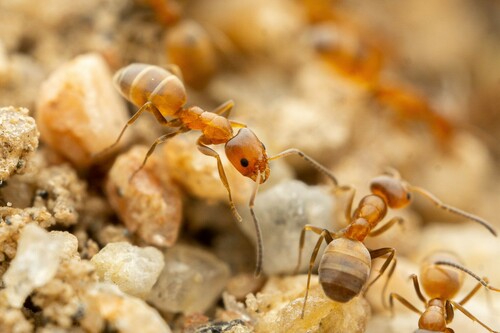


High Noon Ant
forelius pruinosus
The High Noon Ant (Forelius pruinosus) is a remarkable and resilient little insect celebrated for its extraordinary heat tolerance. While most other creatures retreat to the shade during the scorching heat of the midday sun, these tiny ants thrive, actively foraging across hot pavements and sandy soils. This unique timing allows them to exploit food sources without competition from more dominant, heat-sensitive ant species. They form large, multi-queen colonies and are highly efficient foragers, communicating rapidly through chemical trails. Their presence in open, sunny environments makes them a common yet fascinating sight for urban and rural nature spotters alike.
生息地: Typically found in dry, open habitats with sparse vegetation, such as sandy fields, prairies, dunes, and urban sidewalks.
These tiny ants typically measure between 1.8 to 2.5 millimeters in length. They range in color from a dark brown to nearly black, but what truly distinguishes them is a fine, silvery-gray pubescence covering their bodies. This microscopic coating gives them a frosted or 'pruinose' appearance under bright light. They have a relatively smooth, single-segmented petiole that is flattened and hidden beneath the front of their abdomen, and they lack a functional stinger, relying instead on chemical defenses.
カテゴリ
昆虫レア度
Common
危険度
1/5 · 非常に低い
スナップ
最初にスナップしよう!
They are nicknamed 'high noon ants' because their peak activity occurs during the hottest hours of the day when most other insects seek shelter.
Unlike many ant species with a single queen, High Noon Ant colonies are polygynous, meaning they can contain multiple functional queens.
When crushed, these ants release a distinct, pungent odor that is often compared to the smell of rotten coconuts or blue cheese.
They can forage at surface temperatures exceeding 50 degrees Celsius, allowing them to utilize resources when competitors are inactive.
They lay down highly volatile chemical trails from their hindguts, allowing rapid, coordinated mass recruitment to newly discovered food sources.
The fine silvery hair on their bodies reflects solar radiation, helping to prevent overheating while foraging in direct sunlight.
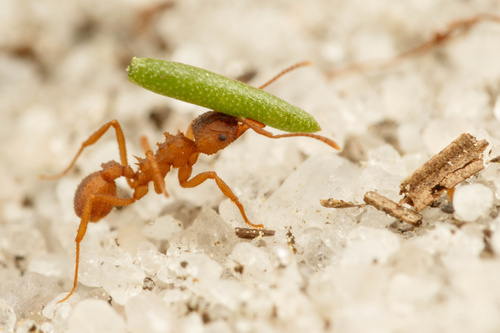
They primarily feed on honeydew secreted by aphids and scale insects, supplemented by scavenging on dead insects and floral nectar.
Aphis nerii
Tends these aphids to harvest their sugary honeydew secretions, protecting them from ladybugs and other predators.
Solenopsis invicta
Competes for foraging space, using its high heat tolerance to forage when the aggressive fire ants are inactive.
このオブジェクトにはまだ特徴バッジが割り当てられていません。
まだ別名はありません。
テーマが追加されると、このオブジェクトのコレクションがここに表示されます。
危険度
1/5 · 非常に低い
まだ特別な安全上の注意はありません。
High Noon Antを識別する最も簡単な方法は、Snappit自然識別アプリを使用することです。
They primarily feed on honeydew secreted by aphids and scale insects, supplemented by scavenging on dead insects and floral nectar.
Typically found in dry, open habitats with sparse vegetation, such as sandy fields, prairies, dunes, and urban sidewalks.
Foraging
ズームインしてクラスターを分割し、このオブジェクトが撮影された場所を探索しましょう。
新しい観察が追加されると、ここに最近のスナップが表示されます。








_dorsal.jpg&width=800)

.jpg&width=800)



