

Hoary Mugwort
artemisia stelleriana
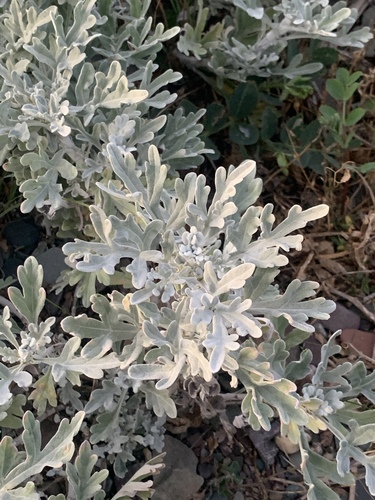
Hoary Mugwort (Artemisia stelleriana), also known as beach wormwood or dusty miller, is an eye-catching perennial plant famed for its striking silver-white foliage. Native to the sandy coasts of Northeast Asia and Northwest North America, it has successfully naturalized along many shorelines of Eastern North America and Northern Europe. Its velvety, deeply lobed leaves look almost frosted, an aesthetic that makes it a beloved choice for rock gardens and coastal landscaping. Beyond its beauty, this resilient plant plays a crucial role in stabilizing sand dunes, helping to prevent coastal erosion with its creeping rhizomes.
生息地: Found on sandy coastal dunes, beaches, and rocky shorelines, often tolerating high wind and salt spray.
This low-growing, mat-forming perennial typically reaches heights of 15 to 60 centimeters. Its most distinctive feature is its dense covering of fine, felt-like white hairs that coat both sides of its deeply-lobed, chrysanthemum-like leaves, giving the plant a silvery, hoary appearance. In mid-to-late summer, it produces small, nodding, pale-yellow flower heads arranged in narrow, leafy clusters. The stems are semi-woody at the base and sprawl across sandy substrates.
カテゴリ
植物レア度
Common
危険度
1/5 · 非常に低い
スナップ
最初にスナップしよう!
Despite its delicate, velvety appearance, Hoary Mugwort is exceptionally tough, capable of surviving extreme winds and temperatures far below freezing.
Its scientific species name 'stelleriana' honors Georg Wilhelm Steller, a pioneering German naturalist who explored Siberia and Alaska in the 18th century.
The silvery hairs on its leaves act like natural sunscreen, reflecting harsh ultraviolet rays away from the plant's delicate tissues.
The thick layer of white, woolly hairs reflects excess solar radiation and reduces water loss through transpiration.
Specialized cellular structures allow the plant to thrive in highly saline environments where other vegetation would dehydrate.
An extensive network of underground stems anchors the plant firmly in shifting coastal dunes, helping to prevent erosion.
As a photosynthetic autotroph, this plant manufactures its own food using sunlight, carbon dioxide, and water while absorbing minerals through its roots.
Bombus pensylvanicus
Pollinated by various bees seeking nectar and pollen from its summer blooms.
Ammophila breviligulata
Grows alongside and competes for space and nutrients in coastal sand dune ecosystems.
Eupithecia absinthiata
The caterpillars of this moth feed on the flowers and foliage of Artemisia species.
このオブジェクトにはまだ特徴バッジが割り当てられていません。
まだ別名はありません。
テーマが追加されると、このオブジェクトのコレクションがここに表示されます。
危険度
1/5 · 非常に低い
まだ特別な安全上の注意はありません。
Hoary Mugwortを識別する最も簡単な方法は、Snappit自然識別アプリを使用することです。
15-60 cm
0.1-1.5 kg
3-10 年
As a photosynthetic autotroph, this plant manufactures its own food using sunlight, carbon dioxide, and water while absorbing minerals through its roots.
Found on sandy coastal dunes, beaches, and rocky shorelines, often tolerating high wind and salt spray.
ズームインしてクラスターを分割し、このオブジェクトが撮影された場所を探索しましょう。
新しい観察が追加されると、ここに最近のスナップが表示されます。














.jpg&width=800)


