

Honey Mushroom
armillaria mellea
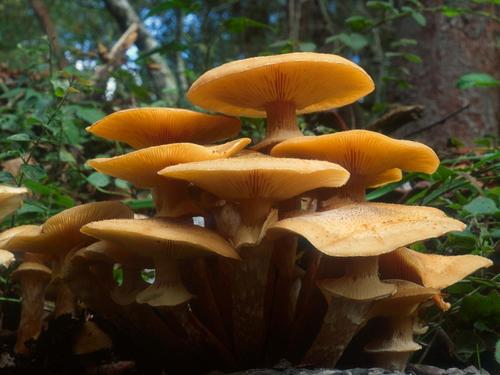
The Honey Mushroom, scientifically known as Armillaria mellea, is a fascinating but formidable species of fungus. Widely recognized for its clustered growth on living trees and decaying wood, this organism plays a dual role in forest ecosystems. It is a highly destructive forest pathogen capable of causing white rot root disease, which slowly weakens and kills a wide variety of hardwood trees. At the same time, it serves as an essential decomposer, recycling nutrients back into the soil from dead organic matter. What makes this fungus truly spectacular is its underground footprint. Individual honey mushrooms are merely the reproductive fruiting bodies of a massive, subterranean network. This underground colonial organism can grow to enormous sizes and survive for centuries, quietly spreading through root-like rhizomorphs. In late autumn, their honey-colored caps emerge in dense, eye-catching clusters, making them a favored find for mushroom foragers and nature enthusiasts alike.
生息地: Typically found in dense deciduous or mixed forests, growing in large clusters at the base of living trees or on decaying stumps.
The fruiting bodies of Armillaria mellea feature convex to flattened caps measuring 3 to 15 centimeters in diameter, displaying a signature honey-yellow to golden-brown color. The cap surface is slightly sticky when moist and is typically dotted with fine, dark, hair-like scales, especially near the center. Below the cap, the gills are whitish to pale yellow, becoming spotted with reddish-brown as they mature. The sturdy, fibrous stem grows 5 to 20 centimeters tall, featuring a persistent, thick, white ring with yellow edges near the top, which is a key identification feature.
カテゴリ
菌類レア度
Common
危険度
1/5 · 非常に低い
スナップ
最初にスナップしよう!
Colonies of related Armillaria species are among the largest and oldest living organisms on Earth, with some covering thousands of acres underground.
Its tough, stringy black rhizomorphs resemble dark shoestrings, earning the fungus the common nickname 'shoestring rot'.
The bioluminescent glow produced by its mycelium in decaying wood is known as 'foxfire' and has been mentioned in literature since ancient times.
Produces thick, root-like fungal cords called rhizomorphs that travel long distances underground to seek out and infect new host trees.
The underground mycelium of this fungus produces a faint, eerie green bioluminescence that glows in the dark inside decaying wood.
Can transition seamlessly from a parasitic pathogen killing living trees to a saprophytic decomposer feeding on dead wood.
Absorbs nutrients by parasitically feeding on the root tissues of living hardwood trees and saprophytically decomposing dead wood.
Quercus robur
Serves as a host parasite, slowly attacking root systems and causing white rot disease.
Ariolimax columbianus
The fruiting bodies are consumed as food by various forest gastropods during damp seasons.
このオブジェクトにはまだ特徴バッジが割り当てられていません。
まだ別名はありません。
テーマが追加されると、このオブジェクトのコレクションがここに表示されます。
危険度
1/5 · 非常に低い
まだ特別な安全上の注意はありません。
Honey Mushroomを識別する最も簡単な方法は、Snappit自然識別アプリを使用することです。
5-20 cm
1-500 年
Absorbs nutrients by parasitically feeding on the root tissues of living hardwood trees and saprophytically decomposing dead wood.
Typically found in dense deciduous or mixed forests, growing in large clusters at the base of living trees or on decaying stumps.
Foraging Blockages Or Host Penetration Via Direct Pressure And Enzymes. Spreads Networks To Seek Targets. Treatment As Foraging. Connection Is Saprotrophic. So Foraging Is A Valid Proxy. Let's Use Foraging. Or We Can Set Huntingmethod To Null. Let's Set To Foraging. Let's Write 'foraging' Inside. Actually, Saprobes Can Use Foraging To Spread Mycelial Cord Networks. Let's Write "foraging" Here. Actually Let's Use "foraging". Or Maybe "foraging" Works Best. Let's Use "foraging". Let's Write "foraging".
ズームインしてクラスターを分割し、このオブジェクトが撮影された場所を探索しましょう。
新しい観察が追加されると、ここに最近のスナップが表示されます。