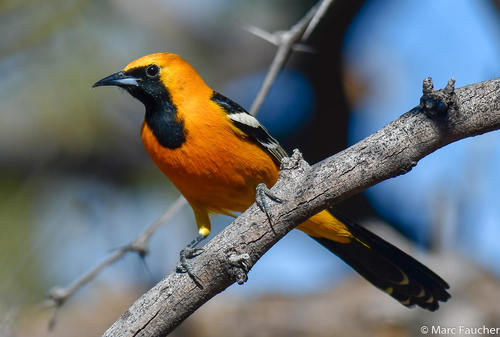


Hooded Oriole
icterus cucullatus
The Hooded Oriole is a slender, vibrant songbird belonging to the blackbird family, Icteridae. Famous for its striking plumage and affinity for palm trees, this bird brings a splash of tropical brilliance to the arid landscapes of the southwestern United States and Mexico. They are migratory visitors during the spring and summer months, captivating birdwatchers with their energetic behavior and sweet, chattering songs. Hooded Orioles are highly adaptable, frequently venturing into suburban parks, orchards, and backyard gardens where they easily associate with human-provided nectar feeders.
生息地: Found in open woodlands, riparian areas, orchards, and suburban parks, with a strong preference for areas planted with palm trees.
Adult males are breathtakingly bright, sporting a brilliant yellow to deep orange hood over their head, nape, and breast, contrasted sharply with a black mask, throat, back, tail, and wings. The wings are adorned with two distinct white wingbars. Females and immature males are much more understated, featuring olive-yellow upperparts, duller yellow underparts, and grayish wings with faint wingbars. They possess a characteristically long, slender, and slightly decurved bill, perfect for probing flowers, and a long, elegant tail that accentuates their slender silhouette.
カテゴリ
鳥類レア度
Common
危険度
1/5 · 非常に低い
スナップ
最初にスナップしよう!
Suburban landscaping with exotic palms has actually allowed the Hooded Oriole to expand its breeding range further north in California than historically recorded.
The Hooded Oriole is nicknamed the 'palm leaf oriole' because of its strong preference for nesting almost exclusively in palm trees, specifically sewing its nest to the underside of palm fronds.
To reach nectar in flowers that are too long or narrow for its beak, the Hooded Oriole will sometimes pierce the base of the flower to 'steal' the nectar from the outside.
Female Hooded Orioles expertly weave intricate, hanging basket-like nests out of palm fibers, sewing them directly to the underside of large palm leaves for shelter.
Possessing a slender, slightly curved bill and a brush-tipped tongue, they can efficiently extract nectar from deep-throated tubular flowers.
They exhibit superb agility, often hanging upside down from twigs, flower clusters, or palm leaves to forage for insects and spiders.
They feed primarily on insects, spiders, nectar, and sweet fruits, adjusting their diet based on seasonal availability.
年齢による違い: Chicks are fed an insect-rich diet high in protein, whereas adults consume more nectar and fruit.
Washingtonia robusta
Utilizes the palm fronds for building its woven nests and foraging for insects.
Molothrus ater
Lays its eggs in the nests of Hooded Orioles, forcing them to raise the cowbird chicks.
Apis mellifera
Competes for nectar at flowers and artificial hummingbird feeders.
このオブジェクトにはまだ特徴バッジが割り当てられていません。
まだ別名はありません。
テーマが追加されると、このオブジェクトのコレクションがここに表示されます。
危険度
1/5 · 非常に低い
まだ特別な安全上の注意はありません。
Hooded Orioleを識別する最も簡単な方法は、Snappit自然識別アプリを使用することです。
They feed primarily on insects, spiders, nectar, and sweet fruits, adjusting their diet based on seasonal availability.
Found in open woodlands, riparian areas, orchards, and suburban parks, with a strong preference for areas planted with palm trees.
Foraging
ズームインしてクラスターを分割し、このオブジェクトが撮影された場所を探索しましょう。
新しい観察が追加されると、ここに最近のスナップが表示されます。









.jpg&width=800)







