

Hydrangea Sphinx
darapsa versicolor
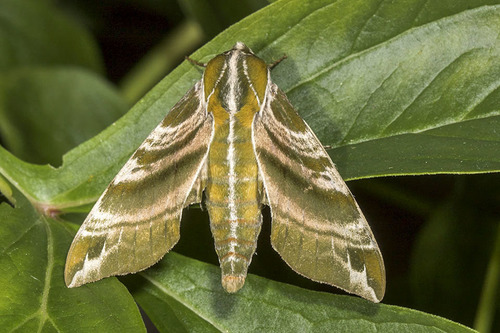
The Hydrangea Sphinx (Darapsa versicolor) is a stunningly vibrant moth belonging to the Sphingidae family, renowned for its intricate, almost stained-glass wing patterns. Native to the damp woodlands and stream banks of eastern North America, this remarkable insect captivates observers with its vivid blends of olive-green, pinkish-orange, and creamy white markings. As an agile flyer, it shares the hovering feeding habits characteristic of many sphinx moths, often earning them the nickname of 'hummingbird moths.' Its presence and life cycle are deeply tied to the specific, undisturbed wetlands where its host plants, notably wild hydrangea and buttonbush, can flourish.
生息地: Found primarily in damp deciduous woodlands, wet meadows, swamps, and along stream banks where host plants like wild hydrangea and buttonbush grow abundantly.
This moth boasts an impressive wingspan typically ranging from 5.8 to 8.0 centimeters. The forewings are beautifully marbled with swirling bands of dark olive-green, contrasting sharply with paler streaks of creamy white and warm pinkish-tan. A distinct pale line often sweeps diagonally across the forewing, highlighting its aerodynamic shape. The hindwings offer a bright pop of color, displaying solid patches of warm orange or pinkish-yellow. The body is robust and streamlined, featuring a pale stripe down the center of its green and brown thorax, perfectly camouflaging the moth among dappled foliage when resting during the daytime.
カテゴリ
昆虫レア度
Common
危険度
1/5 · 非常に低い
スナップ
最初にスナップしよう!
Like many sphinx moths, Hydrangea Sphinx caterpillars have a prominent 'horn' on their rear end, giving them the colloquial nickname of 'hornworms'.
Their scientific name, 'versicolor', hints at the beautifully varied, shifting shades of green, pink, and white that provide their striking camouflage.
They belong to a family of moths that are among the fastest flying insects; some species can maneuver at speeds up to 30 mph (50 km/h).
When threatened, sphinx moth caterpillars often rear up their front half in a rigid pose resembling the ancient Egyptian Sphinx, which inspired the family's name.
Capable of maintaining stationary flight in mid-air using a rapid wingbeat, allowing it to feed from flowers much like a hummingbird.
The intricate, swirling green and pink patterns on its wings break up its outline, helping it blend seamlessly into dappled light and dead leaves.
Equipped with an exceptionally long, coiled proboscis that unrolls to access deep nectar reserves hidden within long, tubular flowers.
Caterpillars munch extensively on the foliage of specific wetland shrubs, while adults use their long proboscis to sip nectar from deep-throated flowers.
年齢による違い: Larvae are strictly folivores that consume leaves of host plants, whereas winged adults are entirely nectarivores.
Hydrangea arborescens
Caterpillars rely heavily on the leaves of the Smooth Hydrangea for food and development.
Cephalanthus occidentalis
Another primary host plant for caterpillars found in swampy environments.
Asclepias syriaca
Adults pollinate and feed heavily on the nectar of Common Milkweed.
Eptesicus fuscus
Preyed upon during flight by nocturnal insectivores like the Big Brown Bat.
このオブジェクトにはまだ特徴バッジが割り当てられていません。
まだ別名はありません。
テーマが追加されると、このオブジェクトのコレクションがここに表示されます。
危険度
1/5 · 非常に低い
まだ特別な安全上の注意はありません。
Hydrangea Sphinxを識別する最も簡単な方法は、Snappit自然識別アプリを使用することです。
3-4 cm
5-8 cm
0.001-0.005 kg
1 年
25 km/h
Caterpillars munch extensively on the foliage of specific wetland shrubs, while adults use their long proboscis to sip nectar from deep-throated flowers.
Found primarily in damp deciduous woodlands, wet meadows, swamps, and along stream banks where host plants like wild hydrangea and buttonbush grow abundantly.
ズームインしてクラスターを分割し、このオブジェクトが撮影された場所を探索しましょう。
新しい観察が追加されると、ここに最近のスナップが表示されます。