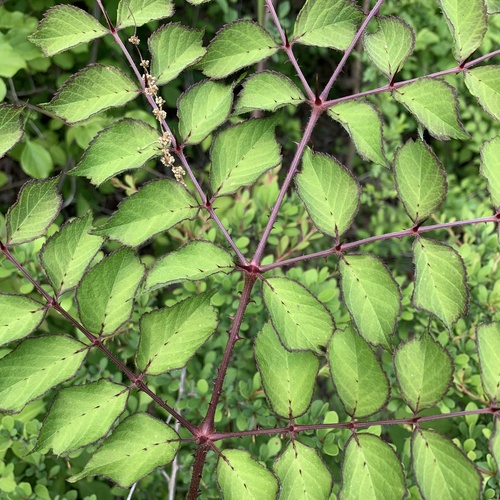


Japanese Angelica Tree
aralia elata
The Japanese Angelica Tree (Aralia elata) is a striking, fast-growing deciduous small tree native to East Asia, including Japan, Korea, China, and eastern Siberia. Known for its sparse branching habit and highly dramatic, umbrella-like silhouette, it commands immediate attention in its native forests. Its stems and branches are aggressively armored with sharp, stout prickles that serve as a strong defense against herbivores, earning it a reputation as a formidable barrier plant in natural ecosystems. In spring, the tree produces highly prized, edible young shoots known as 'tara-no-me' in Japan, which are traditionally harvested and deep-fried as tempura. As summer transitions to autumn, the tree is transformed by massive, cloud-like clusters of tiny white flowers that attract a wealth of pollinators, followed by clusters of small, dark-purple to black berries that feed migrating songbirds.
生息地: Found in open woodlands, forest edges, clearing margins, and disturbed areas where plenty of sunlight is available.
The Japanese Angelica Tree typically grows 3 to 10 meters tall with a sparse, upright form and very few side branches. It features massive, doubly or triply compound pinnate leaves that can reach over a meter in length, giving the crown a lush, exotic appearance. The bark is light grey and heavily armed with sharp, stout prickles. In late summer, large terminal panicles of creamy-white flowers bloom, which later give way to small, glossy black spherical drupes arranged in dense, flat-topped clusters on purplish stems.
カテゴリ
植物レア度
Common
危険度
1/5 · 非常に低い
スナップ
最初にスナップしよう!
Due to its fierce defense of sharp prickles covering the stems, it is colloquially referred to as 'Devil's Walking Stick' in the United States, a name shared with its native North American relative.
In Japan, the young, tender spring shoots are known as 'tara-no-me' and are considered a supreme wild vegetable ('sansai'), typically fried as tempura.
In traditional East Asian medicine, various parts of the tree, especially the bark and roots, are used to treat joint pain, diabetes, and digestive issues.
The trunk, branches, and even the leaf stems are covered in sharp, stout prickles that deter large herbivores from feeding on its foliage.
The plant can easily sprout from root suckers, allowing it to rapidly colonize disturbed areas and recover quickly from physical damage.
Its late-season blooming period produces massive, nectar-rich flower panicles that provide a critical food source for bees and flies when other flowers are scarce.
As a photoautotrophic plant, it manufactures its own food using sunlight, carbon dioxide, and water through photosynthesis, supplemented by minerals absorbed through its root system.
Turdus migratorius
Birds consume the small, dark purple berries in autumn and disperse the seeds through their droppings.
Apis mellifera
Bees, especially honey bees, heavily forage on the abundant nectar-producing flowers during late summer.
Homo sapiens
Humans harvest the tender young shoots in early spring as a culinary delicacy.
このオブジェクトにはまだ特徴バッジが割り当てられていません。
まだ別名はありません。
テーマが追加されると、このオブジェクトのコレクションがここに表示されます。
危険度
1/5 · 非常に低い
まだ特別な安全上の注意はありません。
Japanese Angelica Treeを識別する最も簡単な方法は、Snappit自然識別アプリを使用することです。
300-1000 cm
20-40 年
As a photoautotrophic plant, it manufactures its own food using sunlight, carbon dioxide, and water through photosynthesis, supplemented by minerals absorbed through its root system.
Found in open woodlands, forest edges, clearing margins, and disturbed areas where plenty of sunlight is available.
ズームインしてクラスターを分割し、このオブジェクトが撮影された場所を探索しましょう。
新しい観察が追加されると、ここに最近のスナップが表示されます。

Pennsylvania, US
ここで見られるかも レッサークセランダイン, コマツグミ と オオアマナ.
ガイドを見る →

Connecticut, US
ここで見られるかも ニシキガメ, カミツキガメ と カルミア.
ガイドを見る →

Rhode Island, US
ここで見られるかも オオアオサギ, ニシキガメ と センシティブファーン.
ガイドを見る →