

Juniper Mistletoe
phoradendron juniperinum
Juniper Mistletoe (Phoradendron juniperinum) is an intriguing, hemiparasitic plant native to the arid woodlands of the southwestern United States and northern Mexico. Unlike typical plants that draw sustenance from the soil, this species lives high up in the canopy, anchoring itself directly to the branches of juniper trees. It has adapted to its harsh, dry environment by dramatically reducing its leaves to tiny scales and relying primarily on its host for water and essential minerals. Despite its parasitic nature, Juniper Mistletoe plays an incredibly vital role in desert ecosystems. It serves as an essential food source during the cold winter months when little else is fruiting, attracting a diverse array of birds and insects. This makes it a keystone species in pinyon-juniper habitats, fostering biodiversity where resources are scarce.
生息地: Found primarily in arid and semi-arid pinyon-juniper woodlands, chaparrals, and rocky canyon slopes across the southwestern United States and northern Mexico.
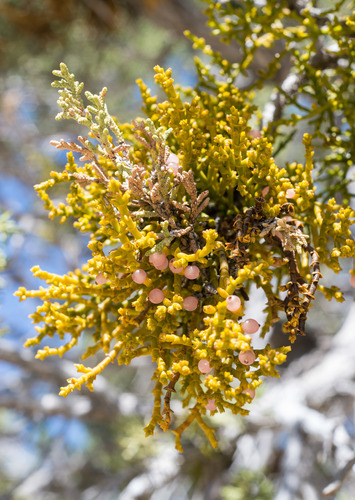
This plant is easily recognized as a dense, rounded clump of yellowish-green to olive-green stems growing out of juniper branches. The stems are smooth, highly branched, and segmented into distinct, jointed sections. Rather than broad foliage, its leaves are reduced to minute, triangular scales, giving the plant a leafless, stick-like appearance. In late autumn and winter, female plants produce abundant, small, fleshy berries that are spherical and range in color from shiny straw-yellow to translucent pinkish-white.
カテゴリ
植物レア度
Common
危険度
1/5 · 非常に低い
スナップ
最初にスナップしよう!
The Phainopepla, a striking desert bird, relies so heavily on Juniper Mistletoe berries in winter that it will fiercely defend individual juniper trees from other birds.
The sticky viscin coating on the seeds acts as a natural glue, allowing them to remain safely anchored on vertical, wind-swept juniper branches until they can sprout.
Unlike other mistletoe species that have broad green leaves, Juniper Mistletoe has leaves reduced to tiny scales, making it look like a cluster of jointed green straws.
The plant develops a specialized root-like structure called a haustorium that penetrates the host juniper's bark to directly access its water and nutrient transport systems.
By reducing its leaves to tiny scales, it minimizes surface area, drastically cutting down on water loss through transpiration in hot, arid climates.
Its seeds are coated in a sticky, gel-like substance called viscin, which allows them to firmly glue themselves to host branches and resist falling off until they germinate.
As a hemiparasite, it derives the majority of its water, minerals, and some carbon directly from the vascular system of its host juniper trees.
年齢による違い: Seeds must germinate and establish a physical connection to a host branch using a haustorium before they can acquire nutrients, surviving initially on stored seed reserves.
Juniperus osteosperma
Serves as the primary host tree supporting the parasite's water and mineral requirements.
Phainopepla nitens
Eats the sticky berries and disperses the viable seeds to new host trees through excretion.
Sialia mexicana
Feeds heavily on the winter berries and aids in the ecological dispersal of the plant's seeds.
このオブジェクトにはまだ特徴バッジが割り当てられていません。
まだ別名はありません。
テーマが追加されると、このオブジェクトのコレクションがここに表示されます。
危険度
1/5 · 非常に低い
まだ特別な安全上の注意はありません。
Juniper Mistletoeを識別する最も簡単な方法は、Snappit自然識別アプリを使用することです。
10-45 cm
0.1-2 kg
10-40 年
As a hemiparasite, it derives the majority of its water, minerals, and some carbon directly from the vascular system of its host juniper trees.
Found primarily in arid and semi-arid pinyon-juniper woodlands, chaparrals, and rocky canyon slopes across the southwestern United States and northern Mexico.
Parasitic Absorption
ズームインしてクラスターを分割し、このオブジェクトが撮影された場所を探索しましょう。
新しい観察が追加されると、ここに最近のスナップが表示されます。