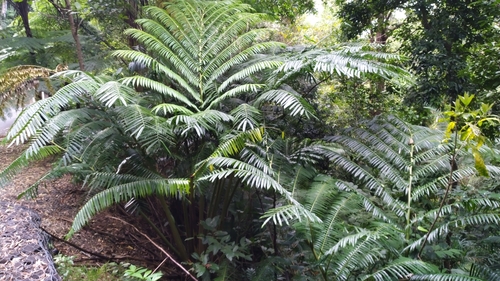


King Fern
angiopteris evecta
The King Fern (Angiopteris evecta), also known as the giant fern or elephant fern, is an ancient, awe-inspiring plant that has survived since the Carboniferous period. Featuring some of the largest fronds of any fern in the world, this botanical giant creates a majestic, prehistoric atmosphere wherever it grows. It is native to the tropical rainforests of Southeast Asia, Oceania, and Madagascar, where it thrives in moist, sheltered ravines. Because of its massive size and evolutionary age, the King Fern is often referred to as a living fossil. It plays a vital role in its ecosystem by stabilizing wet soils and providing dense cover for small forest creatures.
生息地: Found in deep, sheltered rainforest gullies, wet ravines, and near stream banks with high humidity and filtered sunlight.
This spectacular fern is characterized by its massive, fleshy rhizome, which forms a thick, trunk-like base that can reach up to 1 meter in height. Emerging from this base are enormous, glossy-green, bipinnate fronds that arch gracefully and can measure up to 6 to 9 meters in length. The petioles (leaf stalks) are thick, swollen at the base, and can be up to 10 centimeters in diameter, resembling elephant legs. On the underside of mature leaves, double rows of brown, spore-bearing structures called sporangia line the margins.
カテゴリ
植物レア度
Common
危険度
1/5 · 非常に低い
スナップ
最初にスナップしよう!
In some Pacific cultures, the starchy, fleshy rhizome was baked in earth ovens and eaten during times of extreme food scarcity.
Its fronds are among the longest of any fern in the world, occasionally reaching up to 9 meters in length.
The King Fern is a true living fossil, with ancestry tracing back over 300 million years to the Carboniferous period.
Utilizes intense turgor pressure within its massive, water-filled fleshy petioles to keep its giant fronds upright instead of relying on woody tissue.
Features large, fleshy stipules at the base of each frond that store water and nutrients, helping the fern survive dry spells.
Produces millions of microscopic spores on the underside of its leaves, which are easily dispersed by wind and water to colonize new moist sites.
As a photoautotrophic plant, the King Fern synthesizes its own food through photosynthesis, utilizing sunlight, carbon dioxide, water, and soil nutrients.
Glomus spp.
Fungi in the soil form symbiotic relationships with the fern roots to enhance nutrient uptake.
Sus scrofa
Introduced pigs dig up and consume the nutrient-rich, fleshy rhizomes, severely damaging the plant.
Asplenium nidus
Competes for space, light, and nutrients in moist, shaded tropical rainforest understories.
このオブジェクトにはまだ特徴バッジが割り当てられていません。
まだ別名はありません。
テーマが追加されると、このオブジェクトのコレクションがここに表示されます。
危険度
1/5 · 非常に低い
まだ特別な安全上の注意はありません。
King Fernを識別する最も簡単な方法は、Snappit自然識別アプリを使用することです。
300-900 cm
50-600 kg
50-150 年
As a photoautotrophic plant, the King Fern synthesizes its own food through photosynthesis, utilizing sunlight, carbon dioxide, water, and soil nutrients.
Found in deep, sheltered rainforest gullies, wet ravines, and near stream banks with high humidity and filtered sunlight.
Photosynthesis
ズームインしてクラスターを分割し、このオブジェクトが撮影された場所を探索しましょう。
新しい観察が追加されると、ここに最近のスナップが表示されます。

















