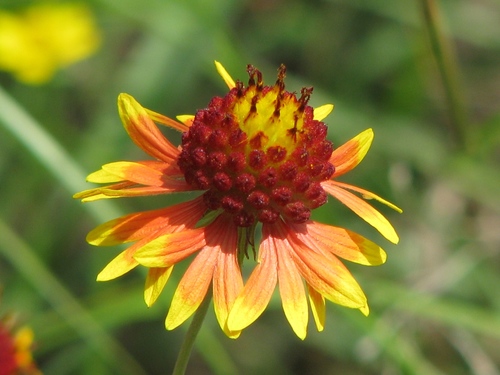


Lanceleaf Blanketflower
gaillardia aestivalis
The Lanceleaf Blanketflower is a resilient and beautiful native wildflower of the southeastern and south-central United States, belonging to the sunflower family. It brings vibrant bursts of color to dry, sandy soils where many other plants struggle to survive. This tough perennial or biennial herb plays a critical role in local ecosystems by supporting a diverse range of native pollinators. Its daisy-like flowers, which bloom throughout the hot summer months, display a stunning array of colors ranging from bright yellow and orange to deep purplish-red.
生息地: Typically found in open, dry areas with sandy soils, including pine flatwoods, sandhills, roadsides, and coastal dunes.
Growing up to 60 cm tall, this plant features narrow, lance-shaped leaves that are alternately arranged along dry, hairy stems. Its solitary flower heads measure about 3 to 5 cm across, showcasing a prominent dome of dark purple or brownish-red disc florets in the center. The outer ray florets can vary, often tipped in bright yellow with purplish-pink bases, or occasionally presenting as entirely yellow or solid dark pink.
カテゴリ
植物レア度
Common
危険度
1/5 · 非常に低い
スナップ
最初にスナップしよう!
The name 'Blanketflower' is thought to refer to the flowers' resemblance to the brightly colored woven blankets handcrafted by Native American tribes.
This species is highly variable in appearance, with some populations having entirely yellow flowers and others displaying deep, solid reddish-purple heads.
Unlike many garden varieties of Gaillardia which are hybrids, Gaillardia aestivalis is a true native wildflower crucial for preserving regional biodiversity.
Developed deep taproots and narrow, hairy leaves that minimize water loss, allowing it to thrive in arid, nutrient-poor sandy soils.
Produces abundant nectar and pollen over a prolonged summer blooming period, attracting dozens of species of bees, butterflies, and beetles.
Adapted to fire-prone ecosystems like longleaf pine savannas, rapidly regenerating from its rootstock or seed bank after a burn.
As an autotrophic plant, it produces its own food through photosynthesis, utilizing sunlight, carbon dioxide, and water while absorbing essential nutrients through its roots.
Apis mellifera
Feeds on nectar and pollen, acting as a primary pollinator.
Bombus pensylvanicus
Feeds on nectar and assists in cross-pollination in pine flatwood habitats.
Gopherus polyphemus
Feeds on the leaves and flowers of low-growing plants in sandy habitats.
このオブジェクトにはまだ特徴バッジが割り当てられていません。
まだ別名はありません。
テーマが追加されると、このオブジェクトのコレクションがここに表示されます。
危険度
1/5 · 非常に低い
まだ特別な安全上の注意はありません。
Lanceleaf Blanketflowerを識別する最も簡単な方法は、Snappit自然識別アプリを使用することです。
30-60 cm
1-3 年
As an autotrophic plant, it produces its own food through photosynthesis, utilizing sunlight, carbon dioxide, and water while absorbing essential nutrients through its roots.
Typically found in open, dry areas with sandy soils, including pine flatwoods, sandhills, roadsides, and coastal dunes.
ズームインしてクラスターを分割し、このオブジェクトが撮影された場所を探索しましょう。
新しい観察が追加されると、ここに最近のスナップが表示されます。














.jpg&width=800)


