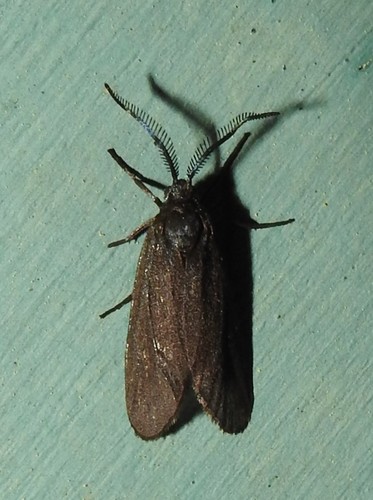


Laurelcherry Smoky Moth
neoprocris floridana
The Laurelcherry Smoky Moth (Neoprocris floridana) is a small, fascinating lepidopteran native to the southeastern United States. Belonging to the Zygaenidae family, also known as burnet or forester moths, this species is noted for its distinctive dark coloration and close evolutionary association with its primary host plant, the Carolina laurelcherry (Prunus caroliniana). While they may seem unassuming at first glance, these day-flying moths play a critical role in their local ecosystems as both specialized herbivores in their larval stage and pollinators as adults. Observing them provides a window into the complex chemical warfare between plants and insects, as they are capable of utilizing host-derived compounds for defense. Their presence in a habitat signals a healthy, diverse maritime forest or mixed woodland understory where their host plants thrive.
生息地: Found in coastal plains, maritime forests, and mixed deciduous woodlands where its host plant, the Carolina laurelcherry, is abundant.
This small moth features uniform, translucent smoky-black or dark gray wings that stretch to a modest wingspan of roughly 1.5 to 2.2 centimeters. Its most striking visual identifier is a bright orange or reddish-yellow collar on the prothorax that contrasts sharply against its dark body and wings. The head is dark, featuring relatively thick, bipectinate (comb-like) antennae in males and simpler antennae in females. Its slender body has a subtle metallic sheen when caught in direct sunlight.
カテゴリ
昆虫レア度
Common
危険度
1/5 · 非常に低い
スナップ
最初にスナップしよう!
Despite being moths, which are traditionally nocturnal, the Laurelcherry Smoky Moth flies in bright daylight to find mates and feed on nectar.
The bright orange collar on their thorax serves as an aposematic warning to predators that they contain nasty-tasting cyanide compounds.
They belong to the family Zygaenidae, an ancient group of moths renowned for their robust chemical defenses and striking metallic colors.
The larvae sequester cyanogenic glycosides from their host plant, making both caterpillars and adult moths toxic or highly unpalatable to potential predators.
Unlike most moth species, this moth is primarily active during the daytime, utilizing bright warning coloration to deter visual predators in full sunlight.
Adults possess sensitive, comb-like antennae that are finely tuned to detect female pheromones and the chemical cues of host plants over long distances.
Larvae feed specifically on the leaves of the Carolina laurelcherry, while adults feed on flower nectar.
Prunus caroliniana
The larvae feed exclusively on the foliage of this evergreen tree, absorbing its defensive compounds.
Anolis carolinensis
Though toxic, naive or specialized predators may occasionally target the diurnal adult moths.
Polistes metricus
Invertebrate predators hunt the vulnerable caterpillar stages on the host plant leaves.
このオブジェクトにはまだ特徴バッジが割り当てられていません。
まだ別名はありません。
テーマが追加されると、このオブジェクトのコレクションがここに表示されます。
危険度
1/5 · 非常に低い
まだ特別な安全上の注意はありません。
Laurelcherry Smoky Mothを識別する最も簡単な方法は、Snappit自然識別アプリを使用することです。
1+ cm
2+ cm
8 km/h
Larvae feed specifically on the leaves of the Carolina laurelcherry, while adults feed on flower nectar.
Found in coastal plains, maritime forests, and mixed deciduous woodlands where its host plant, the Carolina laurelcherry, is abundant.
Grazing
30+
ズームインしてクラスターを分割し、このオブジェクトが撮影された場所を探索しましょう。
新しい観察が追加されると、ここに最近のスナップが表示されます。















