

Lei Triggerfish
sufflamen bursa
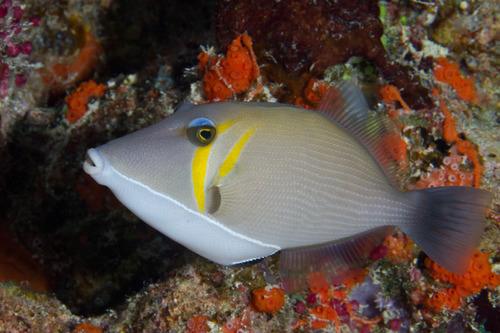
The Lei Triggerfish, also known as the Blackbelly Triggerfish, is a fascinating inhabitant of Indo-Pacific coral reefs. Renowned for its distinctive color patterns and robust body, this species is a common sight among divers and snorkelers. It plays a significant role in the reef ecosystem by preying on various benthic invertebrates, helping to control their populations. Its unique dorsal fin locking mechanism provides a formidable defense against predators, allowing it to wedge itself into crevices.
生息地: Found in coral-rich areas of outer reef slopes, lagoons, and seaward reefs, typically at depths ranging from 3 to 100 meters.
This triggerfish typically reaches about 25-30 cm in length, possessing an oval, laterally compressed body. Its coloration is generally light gray to greenish-brown, transitioning to a paler belly. A prominent, dark brown to black patch often extends from behind the pectoral fin to the anal fin, giving it the "Blackbelly" moniker. It features a distinctive yellow stripe or patch between its eyes and small, intense eyes set high on its head. The fins are typically dark with lighter margins, and its powerful jaws house strong, chisel-like teeth.
カテゴリ
魚類レア度
Common
危険度
1/5 · 非常に低い
スナップ
最初にスナップしよう!
Lei Triggerfish are known to 'spit' water at the sand to uncover buried invertebrates, demonstrating a clever foraging technique.
The 'trigger' in its name comes from its ability to lock its first dorsal spine upright with a smaller, second spine, making it very difficult for predators to pull it out of a crevice.
Unlike many fish that swim primarily with their tail, triggerfish often use their dorsal and anal fins in an undulating motion for propulsion, giving them a unique swimming style.
While generally solitary, during breeding season, a male triggerfish may guard a nest of eggs laid in a shallow depression in the sand or among rubble.
The Lei Triggerfish possesses a unique first dorsal fin that can be locked upright, allowing the fish to wedge itself securely into reef crevices, making it almost impossible for predators to dislodge.
Equipped with strong, chisel-like teeth and powerful jaws, this fish can effectively crush and scrape hard-shelled invertebrates like crabs, sea urchins, and mollusks from the reef.
When threatened, it can rapidly retreat into a crevice and then pump water through its gills to inflate its body slightly, further securing its position and deterring predators.
The Lei Triggerfish is a benthic carnivore, primarily feeding on a variety of invertebrates found on the reef substrate. It uses its strong teeth to scrape and crush its prey.
Carcharhinus amblyrhynchos
A primary food source for larger predatory fish on the reef.
Scaridae
Competes for benthic invertebrate food sources.
Diadema setosum
Preys on these invertebrates, helping to control their populations.
Paguroidea
Consumed by the triggerfish, often targeted for their hard shells.
このオブジェクトにはまだ特徴バッジが割り当てられていません。
まだ別名はありません。
テーマが追加されると、このオブジェクトのコレクションがここに表示されます。
危険度
1/5 · 非常に低い
まだ特別な安全上の注意はありません。
Lei Triggerfishを識別する最も簡単な方法は、Snappit自然識別アプリを使用することです。
20-30 cm
0.5-1.5 kg
5-10 年
25 km/h
The Lei Triggerfish is a benthic carnivore, primarily feeding on a variety of invertebrates found on the reef substrate. It uses its strong teeth to scrape and crush its prey.
Found in coral-rich areas of outer reef slopes, lagoons, and seaward reefs, typically at depths ranging from 3 to 100 meters.
Foraging, Scraping
ズームインしてクラスターを分割し、このオブジェクトが撮影された場所を探索しましょう。
新しい観察が追加されると、ここに最近のスナップが表示されます。