

Littleleaf Sensitive-Briar
mimosa microphylla
The Littleleaf Sensitive-Briar, *Mimosa microphylla*, is a captivating perennial plant known for its delicate appearance and remarkable responsive leaves. Native to the southeastern United States, this member of the pea family (Fabaceae) adds a touch of interactive beauty to open habitats. Its most intriguing feature is its thigmonastic leaves, which rapidly fold inward when touched or disturbed, a phenomenon that has earned it its 'sensitive' moniker. Beyond this unique defense mechanism, it plays an important ecological role, contributing to soil fertility through nitrogen fixation. This resilient plant thrives in sunny, well-drained environments, making it a charming subject for nature enthusiasts and a valuable component of its native ecosystems.
生息地: Typically found in sandy soils of open woodlands, pine flatwoods, disturbed sites, pastures, and roadsides.
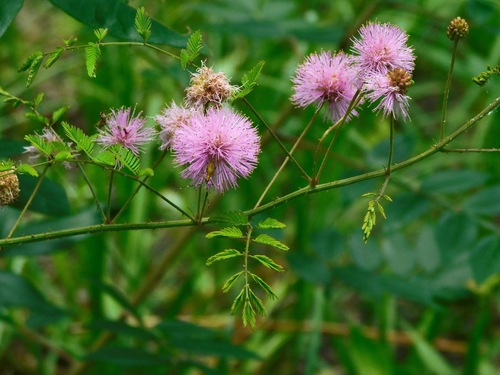
This low-growing perennial forms a sprawling or erect shrublet, typically reaching 30-90 cm (1-3 feet) in height. Its stems are often armed with small, sharp prickles. The most distinctive feature is its bipinnately compound leaves, which are delicate, fern-like, and composed of numerous tiny leaflets that give it a finely textured appearance. When disturbed, these leaflets fold inward along the midrib. The flowers are small, fluffy, globe-shaped clusters, ranging in color from soft pink to purplish-pink, resembling miniature powder puffs. These attractive blooms emerge from spring through fall.
カテゴリ
植物レア度
Common
危険度
1/5 · 非常に低い
スナップ
最初にスナップしよう!
Despite its delicate appearance, it is quite resilient and can thrive in harsh, nutrient-poor, sandy soils due to its nitrogen-fixing capabilities.
Its species name 'microphylla' means 'small-leaved,' referring to its tiny, numerous leaflets.
The rapid folding of its leaves, called thigmonasty, is an adaptation also seen in its famous relative, Mimosa pudica, but *Mimosa microphylla* responds with similar speed.
The leaves of Mimosa microphylla exhibit thigmonasty, quickly folding inward in response to touch, vibration, or even changes in light. This mechanism is thought to deter herbivores or reduce water loss.
As a legume, it forms a symbiotic relationship with specific soil bacteria in its root nodules, allowing it to convert atmospheric nitrogen into a usable form for plant growth, thereby enriching the soil.
This species is well-adapted to dry, sandy, and well-drained soils, possessing mechanisms to cope with periods of low water availability in its natural habitat.
As a plant, Mimosa microphylla produces its own food through photosynthesis, converting sunlight, carbon dioxide, and water into sugars. It also absorbs essential mineral nutrients from the soil.
Apis mellifera
Pollination
Rhizobium species
Nitrogen fixation in root nodules
Odocoileus virginianus
Grazing on foliage
Cicadellidae species
Habitat for various insects
このオブジェクトにはまだ特徴バッジが割り当てられていません。
まだ別名はありません。
テーマが追加されると、このオブジェクトのコレクションがここに表示されます。
危険度
1/5 · 非常に低い
まだ特別な安全上の注意はありません。
Littleleaf Sensitive-Briarを識別する最も簡単な方法は、Snappit自然識別アプリを使用することです。
30-90 cm
2-5 年
As a plant, Mimosa microphylla produces its own food through photosynthesis, converting sunlight, carbon dioxide, and water into sugars. It also absorbs essential mineral nutrients from the soil.
Typically found in sandy soils of open woodlands, pine flatwoods, disturbed sites, pastures, and roadsides.
ズームインしてクラスターを分割し、このオブジェクトが撮影された場所を探索しましょう。
新しい観察が追加されると、ここに最近のスナップが表示されます。

















