

Longhorn Band-Wing Grasshopper
psinidia fenestralis
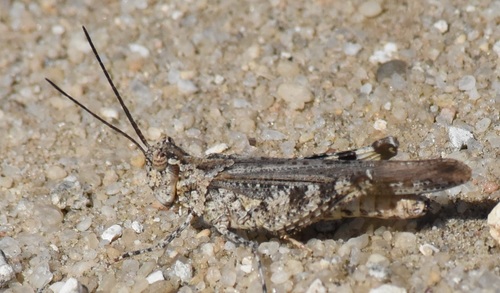
The Longhorn Band-Wing Grasshopper, *Psinidia fenestralis*, is a fascinating insect renowned for its exceptional camouflage and striking aerial displays. This species masterfully blends into its sandy or gravelly surroundings, making it incredibly difficult to spot when at rest. However, when startled, it takes to the air with a flash of brightly colored hindwings, often yellowish or orange, adorned with a distinctive black band. This sudden burst of color and short, erratic flight pattern is a key defense mechanism, designed to disorient potential predators before the grasshopper quickly resettles and disappears into its cryptic background once more. Primarily found in open, dry habitats, it plays a vital role in its ecosystem as a primary consumer of various low-growing plants.
生息地: Typically found in arid or semi-arid environments with sandy soils, such as coastal dunes, disturbed open fields, and gravelly areas, where it blends seamlessly with the substrate.
This grasshopper typically measures between 2 to 3.5 centimeters in length, with a slender body form. Its coloration is highly variable, often a mottled pattern of browns, grays, and blacks, which provides superb camouflage against sandy or gravelly substrates. The forewings (tegmina) are cryptic, mimicking bark or ground debris, while the hindwings, revealed only in flight, are typically bright yellow or orange with a prominent, curved black band. Its antennae are notably long for a band-wing grasshopper, contributing to its 'longhorn' common name, though it is not closely related to longhorn beetles. The powerful hind legs are well-developed for jumping.
カテゴリ
昆虫レア度
Common
危険度
1/5 · 非常に低い
スナップ
最初にスナップしよう!
Despite its common name, the 'longhorn' refers to its antennae, which are longer than those of many other band-wing grasshoppers, rather than referring to any beetle-like features.
Its scientific epithet, *fenestralis*, means 'window-like' or 'pertaining to windows,' possibly alluding to the transparent or semi-transparent areas on its wings.
Males of this species produce a characteristic buzzing or crackling sound, often referred to as 'crepitation,' during their display flights, which is used for courtship and territorial defense.
The 'band-wing' in its name refers to the distinct dark band across its usually yellow or orange hindwings, which is only visible when the grasshopper is in flight.
The grasshopper's mottled brown and grey body coloration allows it to blend almost perfectly with sandy or gravelly substrates, making it exceptionally difficult for predators to detect when motionless.
When disturbed, the grasshopper performs a short, erratic flight, flashing its brightly colored (often yellow or orange) hindwings with a prominent black band. This sudden burst of color disorients predators, allowing it to quickly land and disappear into its camouflaged surroundings.
Equipped with strong, muscular hind legs, the Longhorn Band-Wing Grasshopper can execute impressive leaps to evade threats or traverse its sandy habitat efficiently.
The Longhorn Band-Wing Grasshopper is primarily herbivorous, feeding on a variety of low-growing plants and grasses found within its preferred dry, sandy habitats.
Buteo jamaicensis
A common aerial predator that preys on various large insects, including grasshoppers.
Mantis religiosa
An ambush predator that feeds on a variety of insects, including grasshoppers, using its raptorial forelegs.
Ammophila breviligulata
This grasshopper species often grazes on various native grasses within its sandy habitat.
Asilidae
Fast-flying predatory insects that capture other insects in mid-air, including grasshoppers.
このオブジェクトにはまだ特徴バッジが割り当てられていません。
まだ別名はありません。
テーマが追加されると、このオブジェクトのコレクションがここに表示されます。
危険度
1/5 · 非常に低い
まだ特別な安全上の注意はありません。
Longhorn Band-Wing Grasshopperを識別する最も簡単な方法は、Snappit自然識別アプリを使用することです。
2-3 cm
4-6 cm
0.001-0.004 kg
0 年
The Longhorn Band-Wing Grasshopper is primarily herbivorous, feeding on a variety of low-growing plants and grasses found within its preferred dry, sandy habitats.
Typically found in arid or semi-arid environments with sandy soils, such as coastal dunes, disturbed open fields, and gravelly areas, where it blends seamlessly with the substrate.
Foraging
ズームインしてクラスターを分割し、このオブジェクトが撮影された場所を探索しましょう。
新しい観察が追加されると、ここに最近のスナップが表示されます。




_Tricholauxania_praeusta_-_lateral_view.jpg&width=800)




_Pieris_napi_napi_-_Foret_de_Bouconne%2C_France_-_female.jpg&width=800)





