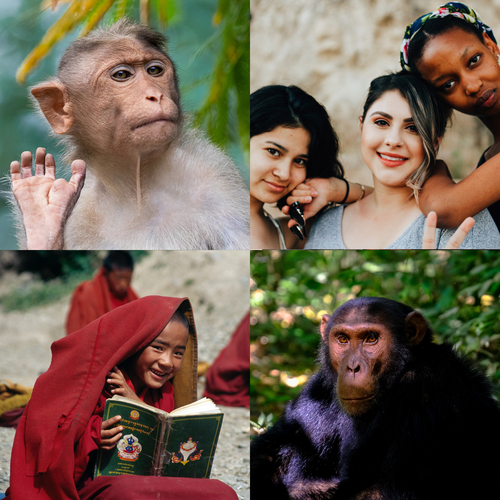


Monkeys, Apes, And Tarsiers
haplorhini
Haplorhini, commonly known as monkeys, apes, and tarsiers, represent a diverse suborder of primates characterized by their forward-facing eyes, often enabling stereoscopic vision, and relatively larger brains compared to strepsirrhine primates. This group includes a vast array of species, from the tiny tarsiers to the massive gorillas, inhabiting diverse environments across the globe. They are renowned for their complex social structures, varied communication methods, and remarkable dexterity, allowing them to navigate intricate arboreal environments and manipulate objects with precision. Their intelligence and adaptability have fascinated humans for centuries, offering profound insights into primate evolution and behavior.
生息地: Haplorhini species are primarily found in tropical and subtropical regions, ranging from dense rainforests and dry deciduous forests to savannas, grasslands, and mountainous areas.
Visually, Haplorhini exhibit a wide range of forms, but common traits include forward-facing eyes, a relatively flattened face (compared to many other mammals), and generally dexterous hands and feet often equipped with nails instead of claws. Fur coloration varies immensely, from the dark coats of gorillas to the vibrant hues of mandrills or the subtle browns and grays of many monkey species. Body sizes range from the small, 10-15 cm tarsiers to large great apes exceeding 1.5 meters in height. Tails can be long and prehensile, long and non-prehensile, short, or entirely absent depending on the species.
カテゴリ
哺乳類レア度
Common
危険度
1/5 · 非常に低い
スナップ
最初にスナップしよう!
Great apes (chimpanzees, bonobos, gorillas, orangutans) share a common ancestor with humans and exhibit remarkably complex cognitive abilities, including tool use, self-recognition, and cultural behaviors.
Many Old World Monkeys possess ischial callosities, which are tough, hairless patches of skin on their buttocks, allowing them to sit comfortably for long periods on branches.
Some New World Monkeys, like spider monkeys and howler monkeys, have prehensile tails strong enough to support their entire body weight, acting as a 'fifth limb'.
Tarsiers, despite being primates, have eyes so large they cannot turn them in their sockets; instead, they can rotate their heads almost 360 degrees.
Possessing highly mobile shoulder joints, grasping hands and feet with opposable thumbs/toes, and often prehensile tails, many haplorhines are exceptionally skilled at climbing, swinging, and navigating complex tree canopies.
Their forward-facing eyes provide excellent depth perception, crucial for judging distances when leaping between branches and for foraging in three-dimensional environments.
Haplorhines utilize a sophisticated repertoire of vocalizations, facial expressions, body postures, and gestures to convey information within their social groups, ranging from alarm calls to affiliative signals.
As a highly diverse group, haplorhini exhibit a broad range of diets, though most are opportunistic omnivores. Their feeding habits depend heavily on species, habitat, and seasonality.
年齢による違い: Infants primarily consume mother's milk, gradually transitioning to solid foods as they mature and learn foraging techniques from their group.
Panthera pardus
Major predator of many haplorhini, especially in African and Asian habitats.
Ficus carica
Provides a crucial food source (fruits) and arboreal habitat for many primate species.
Ascaris spp.
Various species of parasitic worms can inhabit the intestines of primates, impacting their health.
Various Primate Species
Interspecies interactions can involve competition for resources like food and sleeping sites, or even mutualistic relationships such as alarm calling.
このオブジェクトにはまだ特徴バッジが割り当てられていません。
テーマが追加されると、このオブジェクトのコレクションがここに表示されます。
危険度
1/5 · 非常に低い
まだ特別な安全上の注意はありません。
Monkeys, Apes, And Tarsiersを識別する最も簡単な方法は、Snappit自然識別アプリを使用することです。
10-180 cm
0.1-200 kg
10-60 年
40 km/h
As a highly diverse group, haplorhini exhibit a broad range of diets, though most are opportunistic omnivores. Their feeding habits depend heavily on species, habitat, and seasonality.
Haplorhini species are primarily found in tropical and subtropical regions, ranging from dense rainforests and dry deciduous forests to savannas, grasslands, and mountainous areas.
Foraging, Opportunistic Hunting
ズームインしてクラスターを分割し、このオブジェクトが撮影された場所を探索しましょう。
新しい観察が追加されると、ここに最近のスナップが表示されます。









.jpg&width=800)