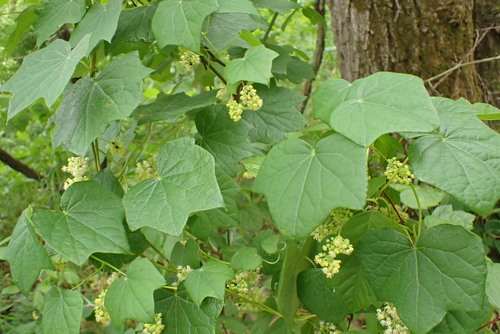


Moonseed
menispermum canadense
Canada Moonseed (Menispermum canadense) is a native, perennial climbing vine found throughout eastern North America. Named for the distinct, crescent-moon-shaped seeds nestled within its dark blue-black berries, this plant scrambles over shrubs and climbs up trees in moist woodland environments. Though it has an elegant, lush appearance with large, lobed leaves, it is a highly toxic plant due to the presence of dangerous alkaloids like dauricine in all of its parts, particularly the roots and seeds. Despite its toxicity to humans and many mammals, Moonseed plays a vital role in its native ecosystem. It provides canopy cover and serves as a host plant for specialized insects. It is also famously known as a deceptive double for wild grapes, a resemblance that can lead to accidental poisoning for foragers who do not pay close attention to leaf attachment and the absence of climbing tendrils.
生息地: Typically found in moist, deciduous woodlands, thickets, floodplains, and along stream banks.
This woody deciduous vine climbs up to 6 meters high by twining its stems, completely lacking the climbing tendrils found on wild grapes. The leaves are alternate and broadly ovate or rounded, measuring 10 to 20 cm across with 3 to 7 shallow lobes, typically displaying a peltate structure where the leaf stem attaches slightly inside the lower leaf margin rather than at the edge. Small, inconspicuous greenish-yellow flowers bloom in late spring, giving way to hanging clusters of bluish-black, waxy berries in late summer. Each berry contains a single, flattened, crescent-shaped seed that provides a definitive diagnostic feature for identification.
カテゴリ
植物レア度
Common
危険度
1/5 · 非常に低い
スナップ
最初にスナップしよう!
Despite its severe toxicity, some Native American tribes historically used extremely small, prepared doses of the root as a dermatological aid.
Moonseed is a highly dangerous lookalike to wild grapes; mistaking it for grapes can be fatal as all parts contain toxic dauricine.
The scientific name Menispermum directly translates to crescent moon seed, reflecting its uniquely shaped seeds.
You can easily tell Moonseed apart from grapes because Moonseed completely lacks climbing tendrils, relying entirely on twining.
The vine climbs efficiently by tightly winding its woody stems spirally around supporting vegetation, allowing it to reach canopy sunlight without needing tendrils.
Produces toxic alkaloids, particularly dauricine, throughout its tissues to deter herbivores and prevent insect predation.
The leaf petiole attaches near the center of the leaf, allowing the broad blades to rotate and maximize sunlight capture in shaded forest understories.
As a photosynthetic plant, it synthesizes its own sugars from sunlight, water, and carbon dioxide, while absorbing essential minerals through its root system.
Plusiodonta compressipalpis
The caterpillars of this specialized moth feed almost exclusively on the leaves of the Canada Moonseed.
Turdus migratorius
Robins eat the berries in autumn and assist in seed dispersal, unaffected by the plant's toxins.
Vitis riparia
Competes for climbing support and sunlight in moist riparian edge habitats.
このオブジェクトにはまだ特徴バッジが割り当てられていません。
まだ別名はありません。
テーマが追加されると、このオブジェクトのコレクションがここに表示されます。
危険度
1/5 · 非常に低い
まだ特別な安全上の注意はありません。
Moonseedを識別する最も簡単な方法は、Snappit自然識別アプリを使用することです。
200-600 cm
10-40 年
As a photosynthetic plant, it synthesizes its own sugars from sunlight, water, and carbon dioxide, while absorbing essential minerals through its root system.
Typically found in moist, deciduous woodlands, thickets, floodplains, and along stream banks.
ズームインしてクラスターを分割し、このオブジェクトが撮影された場所を探索しましょう。
新しい観察が追加されると、ここに最近のスナップが表示されます。










_Hydrangea_macrophylla%2C_Iwafune%2C_Isumi%2C_Chiba%2C_Japan_2.jpg&width=800)
