

Moth Flies And Sand Flies
psychodidae
The family Psychodidae, commonly known as moth flies and sand flies, is a fascinating group of tiny, hairy dipterans that occupy a wide range of ecological niches. While some species within this family are harmless and play a crucial role in decomposing organic matter, others, such as sand flies, are medical vectors of high significance. These insects are easily recognized by their compact, furry bodies and moth-like appearance, often found fluttering with short, erratic hops around damp environments, organic waste, or sheltered outdoor hideaways. Moth flies, often called drain flies, are common household companions, thriving in the gelatinous films of plumbing systems where their larvae feed on bacteria and decaying sludge. Sand flies, on the other hand, are highly adapted terrestrial insects that inhabit arid regions, forest floors, and rodent burrows. This family illustrates the incredible diversity of dipterans, ranging from harmless nutrient recyclers to key organisms in epidemiological research.
生息地: They are typically found in moist, shade-heavy environments containing decaying organic matter, such as bathroom drains, sewage beds, marshlands, moist leaf litter, and rodent burrows.
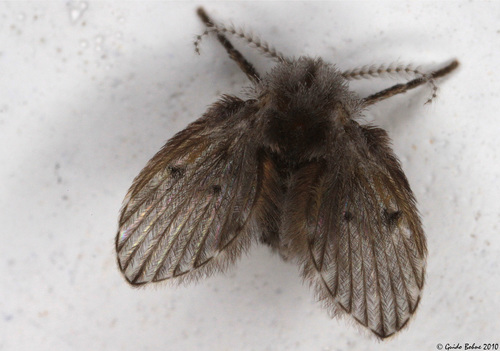
Moth flies and sand flies are exceptionally small insects, typically measuring between 1 and 6 millimeters in length. They are characterized by their densely hairy bodies and wings, which give them a fuzzy, moth-like texture. Their wings are broad, pointed, and held roof-like or flat over the body at rest, often forming a distinct heart shape when viewed from above. Their coloration is generally drab, ranging from pale tan and gray to dark brown, allowing them to blend seamlessly into shadows, soil, or decay. They possess long, bead-like antennae and lack the strong, direct flight patterns of other flies, instead moving in short, jerky leaps.
カテゴリ
昆虫レア度
Common
危険度
1/5 · 非常に低い
スナップ
最初にスナップしよう!
Despite being true flies of the order Diptera, moth flies get their common name from the thick coat of hair on their bodies and wings that makes them resemble miniature moths.
The larvae of drain flies can survive in highly toxic environments like bleach-treated drains and sewers, and some species can even survive temporarily without oxygen.
When resting on walls, moth flies hold their wings at a specific angle that makes them resemble a tiny heart, earning them the nickname 'heart-shaped flies'.
Their bodies and wings are covered in highly water-repellent hairs, allowing them to survive in wet drains without drowning.
Instead of sustained flying, they utilize short, jerky hops that make them difficult for predators to track and capture.
Larvae possess specialized mouthparts and respiratory tubes that allow them to live and feed within toxic sewage biofilms.
Larvae primarily feed on decaying organic material, algae, and bacterial biofilms, while adults feed on plant nectar, sap, or, in some species, vertebrate blood.
Parasteatoda tepidariorum
Commonly preyed upon by household spiders that spin webs near damp areas where these flies emerge.
Leishmania donovani
Female sand flies serve as the principal vector transmitting the flagellate protozoan parasite to mammalian hosts.
このオブジェクトにはまだ特徴バッジが割り当てられていません。
まだ別名はありません。
テーマが追加されると、このオブジェクトのコレクションがここに表示されます。
危険度
1/5 · 非常に低い
まだ特別な安全上の注意はありません。
Moth Flies And Sand Fliesを識別する最も簡単な方法は、Snappit自然識別アプリを使用することです。
0.000001+ kg
2 km/h
Larvae primarily feed on decaying organic material, algae, and bacterial biofilms, while adults feed on plant nectar, sap, or, in some species, vertebrate blood.
They are typically found in moist, shade-heavy environments containing decaying organic matter, such as bathroom drains, sewage beds, marshlands, moist leaf litter, and rodent burrows.
Foraging Block Feeding Female Sand Flies Use Pool Feeding Strategies To Ingest Blood. Working As Foragers Most Of Their Lives.
30+
1+ 日
ズームインしてクラスターを分割し、このオブジェクトが撮影された場所を探索しましょう。
新しい観察が追加されると、ここに最近のスナップが表示されます。



.jpg)
_1.jpg&width=800)