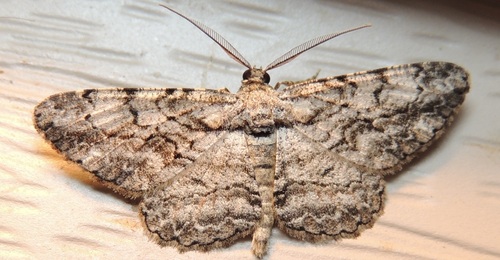


North American Common Gray
anavitrinella pampinaria
The North American Common Gray (Anavitrinella pampinaria) is a master of disguise in the moth world. Found widely across North American deciduous forests and suburban gardens, this subtle insect blends seamlessly into its surroundings, making it a delight for sharp-eyed nature spotters. As a member of the family Geometridae, its caterpillars are classic 'inchworms' that move with a charming looping gait. These moths play a vital role in their ecosystems as both herbivores during their larval stage and as a critical food source for bats, birds, and other nocturnal predators.
生息地: Found in deciduous forests, mixed woodlands, suburban gardens, and orchards where their larval host plants are abundant.
Adults of this species feature a wingspan ranging from 2.2 to 3.8 cm, with wings heavily mottled in shades of gray, white, and dusky brown. They display fine, dark, wavy lines running horizontally across both the forewings and hindwings, which mimic the cracks and crevices of tree bark. When resting, they hold their wings flat against the substrate, eliminating shadows and enhancing their camouflage. The caterpillars are highly variable, ranging from light green to deep brown, often mimicking small twigs.
カテゴリ
昆虫レア度
Common
危険度
1/5 · 非常に低い
スナップ
最初にスナップしよう!
Adults always rest with their wings held entirely flat against surfaces, which eliminates cast shadows and prevents visual detection by predators.
The common name 'inchworm' comes from the looping motion of the caterpillars, which historically made it look like they were measuring the earth inch by inch.
To escape hungry birds, the caterpillars can stiffen their bodies at an angle from branches to perfectly mimic a broken twig.
The intricate gray and white wing patterns perfectly match lichen-covered tree bark, rendering the resting moth nearly invisible to predators.
To escape avian predators, the caterpillars can stiffen their bodies and stand at an angle from a branch, perfectly mimicking a dead twig.
Adults possess tympanic organs capable of detecting ultrasonic bat echolocation, prompting them to perform rapid evasive diving maneuvers.
Larvae feed on the leaves of various deciduous trees and shrubs, while adults occasionally sip nectar and moisture.
年齢による違い: Caterpillars chew on leafy foliage, whereas the adult moths sip nectar or fluids using a proboscis.
Prunus serotina
The leaves of the Black Cherry tree serve as a primary food source for the Common Gray caterpillars.
Myotis lucifugus
The Little Brown Bat is a major nocturnal predator of adult Common Gray moths.
Cyanocitta cristata
Blue Jays forage in deciduous foliage and frequently consume both Common Gray larvae and resting adults.
このオブジェクトにはまだ特徴バッジが割り当てられていません。
まだ別名はありません。
テーマが追加されると、このオブジェクトのコレクションがここに表示されます。
危険度
1/5 · 非常に低い
まだ特別な安全上の注意はありません。
North American Common Grayを識別する最も簡単な方法は、Snappit自然識別アプリを使用することです。
0.00010124300350105316+ kg
Larvae feed on the leaves of various deciduous trees and shrubs, while adults occasionally sip nectar and moisture.
Found in deciduous forests, mixed woodlands, suburban gardens, and orchards where their larval host plants are abundant.
Foraging
ズームインしてクラスターを分割し、このオブジェクトが撮影された場所を探索しましょう。
新しい観察が追加されると、ここに最近のスナップが表示されます。



_(2).JPG&width=800)










.JPG&width=800)

