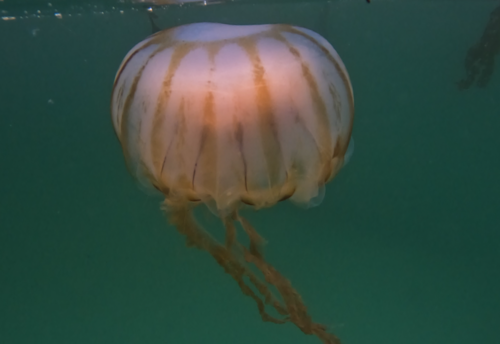


Northern Sea Nettle
chrysaora melanaster
The Northern Sea Nettle (Chrysaora melanaster) is a stunning and ecologically vital species of jellyfish inhabiting the chilly waters of the North Pacific. Easily recognized by its golden-brown bell and elegant dark stripes, this sea nettle is a key predator in pelagic ecosystems. During late summer, they can form massive blooms in the Bering Sea, dominating the biomass of the region and significantly shaping the local marine food web. Despite their delicate appearance, these jellyfish are formidable hunters that use their long, stinging tentacles to capture zooplankton, krill, and small fish.
生息地: Found in the cold, pelagic and coastal waters of the North Pacific Ocean, particularly within the Bering Sea and Gulf of Alaska.
This large jellyfish features a dome-shaped bell that typically grows 30 to 60 centimeters in diameter, characterized by a translucent cream or yellowish background adorned with 16 distinct dark brown radiating stripes resembling wheel spokes. Hanging from the center of the bell are four long, highly ruffled, reddish-brown oral arms. Surrounding the margin of the bell are 24 long, thin, trailing tentacles that can extend several meters in length.
カテゴリ
Animalレア度
Common
危険度
1/5 · 非常に低い
スナップ
最初にスナップしよう!
During massive blooms, the collective weight of these jellyfish in the Bering Sea can reach up to several million metric tons.
The scientific species name 'melanaster' translates to 'black star' in Greek, referring to the dark radiating star pattern on its bell.
Young fish often seek shelter beneath the bell and among the venomous tentacles of the sea nettle, gaining protection from larger predators.
Possesses specialized stinging cells along its tentacles that inject toxins to paralyze prey and ward off predators.
Uses rhythmic contractions of its muscular bell to create water currents, allowing it to move vertically through the water column.
Can rapidly repair damaged tissue and regenerate lost tentacles or oral arms after predatory attacks.
Feeds heavily on a variety of zooplankton, small fish, larval fish, and other jellyfish species drift-caught in its tentacles.
年齢による違い: Polyp stages feed on microscopic organic particles, whereas the mature medusa stages hunt active zooplankton and small fish.
Dermochelys coriacea
Adult turtles feed on jellyfish swarms as a major source of hydration and nutrients.
Gadus chalcogrammus
Competes for zooplankton food sources and occasionally feeds on pollock larvae.
このオブジェクトにはまだ特徴バッジが割り当てられていません。
まだ別名はありません。
テーマが追加されると、このオブジェクトのコレクションがここに表示されます。
危険度
1/5 · 非常に低い
まだ特別な安全上の注意はありません。
Northern Sea Nettleを識別する最も簡単な方法は、Snappit自然識別アプリを使用することです。
30-60 cm
1-5 kg
1-2 年
Feeds heavily on a variety of zooplankton, small fish, larval fish, and other jellyfish species drift-caught in its tentacles.
Found in the cold, pelagic and coastal waters of the North Pacific Ocean, particularly within the Bering Sea and Gulf of Alaska.
Ambush
ズームインしてクラスターを分割し、このオブジェクトが撮影された場所を探索しましょう。
新しい観察が追加されると、ここに最近のスナップが表示されます。



