

Notch-Leaf Scorpionweed
phacelia crenulata
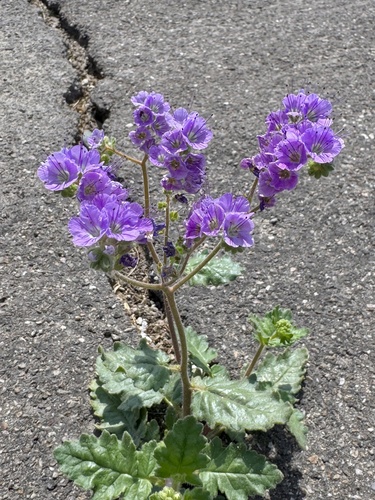
The Notch-Leaf Scorpionweed (Phacelia crenulata) is a striking annual wildflower native to the arid desert regions of the southwestern United States and northern Mexico. It is renowned for its vibrant, violet-blue, bell-shaped blossoms clustered in coils that resemble a scorpion's tail, which gives the plant its descriptive common name. While beautiful to behold in the spring when desert superblooms paint the landscape, this plant carries a potent secret: its foliage is coated in glandular hairs that secrete irritating oils, capable of causing a severe, itchy skin rash similar to poison ivy for unsuspecting hikers and botanists. Despite this fierce defense, it serves as a critical early-season resource for desert pollinators, offering vital nectar when few other plants are in bloom.
生息地: Found in dry, sandy, gravelly, or rocky soils of desert flats, washes, and slopes, typically within the Mojave, Sonoran, and Great Basin deserts.
This annual herb typically grows upright from 10 to 80 centimeters tall. It features dark green, deeply lobed or notched leaves with wavy margins that are covered in sticky, glandular hairs. The most distinctive feature is its terminal coiled flower stalks that unfurl as the blossoms open. The flowers themselves are bell-shaped, measuring about 6 to 10 millimeters across, with deep violet-purple to blue petals and prominent, long-exserted stamens that extend far beyond the corolla, giving the flower cluster a delicate, fuzzy appearance.
カテゴリ
植物レア度
Common
危険度
1/5 · 非常に低い
スナップ
最初にスナップしよう!
Despite being toxic or highly irritating to most mammals, it is a crucial early spring food source for specialized desert bees.
The common name 'Scorpionweed' refers to the tightly coiled flower clusters which strongly resemble the curved tail of a scorpion.
Touching the plant can cause a severe rash (allergic contact dermatitis) indistinguishable from poison ivy, caused by glandular secretions.
Coiled flower spikes slowly unfurl to ensure sequential blooming, maximizing pollination success over an extended period in unpredictable desert conditions.
Glandular trichomes secrete geranylhydroquinone, a sticky oil that causes painful contact dermatitis to deter grazing mammalian herbivores.
Seeds have a long-lived viability that allows them to remain dormant in desert soils for years, germinating only when winter rainfall thresholds are met.
As a photoautotrophic plant, it produces its own energy through photosynthesis, utilizing sunlight, carbon dioxide, and water.
Osmia lignaria
Provides essential nectar and pollen during early spring to native desert bees.
Gopherus agassizii
Desert tortoises sometimes feed on the vegetation despite the irritating hairs.
このオブジェクトにはまだ特徴バッジが割り当てられていません。
まだ別名はありません。
テーマが追加されると、このオブジェクトのコレクションがここに表示されます。
危険度
1/5 · 非常に低い
まだ特別な安全上の注意はありません。
Notch-Leaf Scorpionweedを識別する最も簡単な方法は、Snappit自然識別アプリを使用することです。
10-80 cm
1 年
As a photoautotrophic plant, it produces its own energy through photosynthesis, utilizing sunlight, carbon dioxide, and water.
Found in dry, sandy, gravelly, or rocky soils of desert flats, washes, and slopes, typically within the Mojave, Sonoran, and Great Basin deserts.
ズームインしてクラスターを分割し、このオブジェクトが撮影された場所を探索しましょう。
新しい観察が追加されると、ここに最近のスナップが表示されます。

California, US
ここで見られるかも クレオソートブッシュ, Desert Holly と Cottontop Cactus.
ガイドを見る →

California, US
ここで見られるかも Black-Tailed Gnatcatcher, ブリットルブッシュ と ミヤマシトド.
ガイドを見る →

California, US
ここで見られるかも Desert Holly, Desert Sunflower と Desert Fivespot.
ガイドを見る →


