

Nuttall'S Violet
viola nuttallii
Nuttall's Violet (Viola nuttallii) is a delightful perennial wildflower that graces the arid landscapes of western North America. Flowering early in the spring, it brings a cheerful splash of yellow to sagebrush prairies, pine forests, and grassy hillsides. This hardy species has adapted perfectly to semi-arid conditions, relying on a robust taproot and fleshy leaves to survive dry periods. It is highly valued by local wildlife, serving as a critical early-season pollen source for native bees and a primary larval host for several species of fritillary butterflies. Its presence signifies a healthy, undisturbed native grassland or steppe ecosystem.
生息地: Typically found in dry grasslands, sagebrush steppes, and open pine woodlands across western North America.
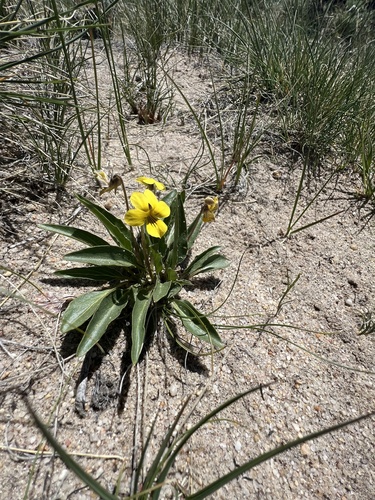
This low-growing perennial reaches heights of 5 to 25 centimeters. It is easily recognized by its bright yellow, five-petaled flowers, which often display subtle brownish-purple veins on the lower petals. Its leaves are lanceolate to oblong, tapering down to long petioles, and have a somewhat fleshy texture with a light-green to greyish-green hue.
カテゴリ
植物レア度
Common
危険度
1/5 · 非常に低い
スナップ
最初にスナップしよう!
During dry summers, the plant may go completely dormant to preserve resources until the next spring.
It is named in honor of Thomas Nuttall, an influential 19th-century English botanist who collected thousands of North American specimens.
The seeds are physically transported underground by ants who eat only the fatty elaiosome attachment, leaving the seed to germinate safely.
Lures ants with a lipid-rich seed appendage called an elaiosome, prompting them to carry and plant the seeds in underground nests.
Produces hidden, closed flowers close to the ground that self-pollinate, ensuring seed production even in poor weather.
Employs thick, fleshy leaves and a deep taproot to endure the dry, hot summers of the western sagebrush plains.
Like all plants, it produces energy through photosynthesis, utilizing sunlight, carbon dioxide, and soil minerals.
Speyeria callippe
Larvae feed exclusively on the leaves of this violet.
Formica obscuripes
Disperses seeds by carrying them to underground nests.
Apis mellifera
Visits flowers for nectar and acts as an early spring pollinator.
このオブジェクトにはまだ特徴バッジが割り当てられていません。
まだ別名はありません。
テーマが追加されると、このオブジェクトのコレクションがここに表示されます。
危険度
1/5 · 非常に低い
まだ特別な安全上の注意はありません。
Nuttall'S Violetを識別する最も簡単な方法は、Snappit自然識別アプリを使用することです。
5-25 cm
0.01-0.05 kg
2-10 年
Like all plants, it produces energy through photosynthesis, utilizing sunlight, carbon dioxide, and soil minerals.
Typically found in dry grasslands, sagebrush steppes, and open pine woodlands across western North America.
ズームインしてクラスターを分割し、このオブジェクトが撮影された場所を探索しましょう。
新しい観察が追加されると、ここに最近のスナップが表示されます。









