

Ochre Club
clavariadelphus ligula
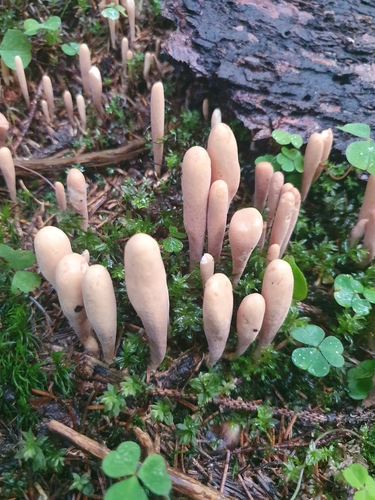
The Ochre Club (Clavariadelphus ligula) is a distinctive member of the fungal kingdom, easily recognized by its unique club-shaped fruiting body. This fascinating fungus plays a vital ecological role as a saprobe, actively participating in the decomposition of organic matter on the forest floor. Often found in coniferous woodlands, it helps recycle nutrients back into the ecosystem, supporting the health and vitality of these dense environments. Its appearance, reminiscent of a small, blunt tongue or club emerging from the leaf litter, makes it an intriguing find for naturalists and mushroom enthusiasts alike, offering a glimpse into the intricate processes of nature's recycling team.
生息地: Found in dense coniferous forests, particularly under pine trees, often on decaying needles, woody debris, or buried wood.
The Ochre Club typically presents a slender, club-shaped fruiting body, tapering slightly towards the base and rounded or somewhat flattened at the apex. It measures between 3 to 10 centimeters in height and 0.5 to 1.5 centimeters in width. The color ranges from a vibrant ochre-yellow to a duller yellow-brown or reddish-brown, often becoming darker with age or bruising. The surface is typically smooth, sometimes finely velvety, and the flesh is firm but pliant. It lacks gills, pores, or a distinct cap and stem, appearing as a singular, upright structure emerging directly from its substrate.
カテゴリ
菌類レア度
Common
危険度
1/5 · 非常に低い
スナップ
最初にスナップしよう!
Despite its common name, "club," its shape is often described as resembling a small, blunt tongue or an upright finger.
It belongs to the Gomphales order, which includes a diverse group of fungi often characterized by their coral-like or club-like fruiting bodies.
The mycelial network of the Ochre Club plays a crucial role in maintaining forest health by breaking down complex cellulose and lignin, preventing excessive build-up of organic debris.
Unlike many mushrooms that have gills or pores, the Ochre Club produces its spores on the smooth surface of its club-shaped body.
It effectively breaks down tough organic matter like conifer needles and fallen wood, returning essential nutrients to the soil.
By decomposing complex organic compounds, Clavariadelphus ligula contributes significantly to the forest's nutrient cycle, making nutrients available for plants and other organisms.
Its subdued ochre and brown coloration allows it to blend seamlessly with the forest floor, offering a degree of protection from casual observation.
The Ochre Club is a saprobic fungus, meaning it obtains its nutrients by decomposing dead organic matter, primarily conifer needles and woody debris.
Pinus sylvestris
Provides a substrate and contributes to the breakdown of organic matter from these trees.
Thelephora terrestris
Compete for resources on the forest floor, though occupying slightly different niches.
Arion rufus
Small forest invertebrates, such as slugs or certain beetle larvae, may consume the fruiting bodies.
このオブジェクトにはまだ特徴バッジが割り当てられていません。
まだ別名はありません。
テーマが追加されると、このオブジェクトのコレクションがここに表示されます。
危険度
1/5 · 非常に低い
まだ特別な安全上の注意はありません。
Ochre Clubを識別する最も簡単な方法は、Snappit自然識別アプリを使用することです。
3-10 cm
0.005-0.02 kg
1-5 年
The Ochre Club is a saprobic fungus, meaning it obtains its nutrients by decomposing dead organic matter, primarily conifer needles and woody debris.
Found in dense coniferous forests, particularly under pine trees, often on decaying needles, woody debris, or buried wood.
Foraging
ズームインしてクラスターを分割し、このオブジェクトが撮影された場所を探索しましょう。
新しい観察が追加されると、ここに最近のスナップが表示されます。