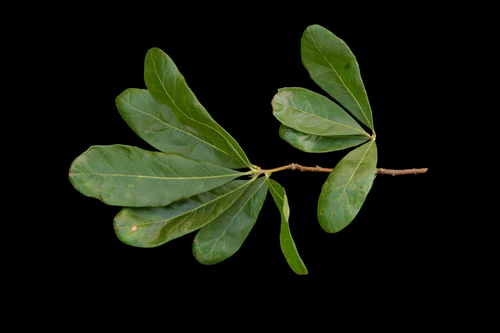


Oglethorpe Oak
quercus oglethorpensis
The Oglethorpe Oak is a rare and remarkable deciduous tree native to the southeastern United States, primarily found within the Piedmont region. First discovered in 1940 in Georgia, this elegant oak species is highly valued for its unique botanical profile and its adaptation to damp, heavy clay soils. It typically forms a medium-sized tree with a narrow, compact crown, bringing quiet majesty to the damp flatwoods and bottomland habitats it calls home. Today, it is a prized find for plant enthusiasts due to its rarity and status as an endangered relic of the American southeast.
生息地: Found in wet, poorly drained soils of flatwoods, bottomland forests, and along riverbanks in the southeastern United States.
This tree grows to heights of 15 to 25 meters, featuring a straight trunk with light gray, scaly bark that breaks into shallow plates. Its most distinctive feature is its foliage: the leaves are narrow, elliptical, and entirely lack the lobes or teeth typical of most other oaks. The leaves are smooth and dark green on top, contrasted by a velvety, yellowish-pubescent underside. In the autumn, the canopy turns to subtle yellow and brown hues, and it produces small, egg-shaped acorns measuring about 1 to 1.5 centimeters in length, seated in shallow, scaly cups.
カテゴリ
植物レア度
Common
危険度
1/5 · 非常に低い
スナップ
最初にスナップしよう!
It is one of the few oak species that actively struggles with chestnut blight, a disease famous for wiping out the American Chestnut tree.
Its leaves completely lack lobes or teeth, meaning it is frequently mistaken for a willow oak or a bay tree by casual observers.
The Oglethorpe Oak went completely unnoticed by the scientific community until botanist Wilbur H. Duncan first described it in Georgia in 1940.
It can persist and even reach maturity while hosting the chestnut blight fungus, showing higher tolerance than many other susceptible tree species.
Its specialized root biology allows it to thrive in heavy, oxygen-deficient clay soils that are seasonally saturated with water.
Its seeds regulate germination timing to coincide with optimal spring moisture levels, preventing premature winter sprouting.
As a photoautotrophic plant, the Oglethorpe Oak produces its own food through photosynthesis, utilizing sunlight, water, and carbon dioxide.
Cryphonectria parasitica
The pathogenic fungus infects the bark of the Oglethorpe Oak, causing cankers and branch dieback.
Sciurus carolinensis
Feeds on the nutritious acorns and assists in seed dispersal by caching them in the soil.
このオブジェクトにはまだ特徴バッジが割り当てられていません。
まだ別名はありません。
テーマが追加されると、このオブジェクトのコレクションがここに表示されます。
危険度
1/5 · 非常に低い
まだ特別な安全上の注意はありません。
Oglethorpe Oakを識別する最も簡単な方法は、Snappit自然識別アプリを使用することです。
1500-2500 cm
80-150 年
As a photoautotrophic plant, the Oglethorpe Oak produces its own food through photosynthesis, utilizing sunlight, water, and carbon dioxide.
Found in wet, poorly drained soils of flatwoods, bottomland forests, and along riverbanks in the southeastern United States.
ズームインしてクラスターを分割し、このオブジェクトが撮影された場所を探索しましょう。
新しい観察が追加されると、ここに最近のスナップが表示されます。



















