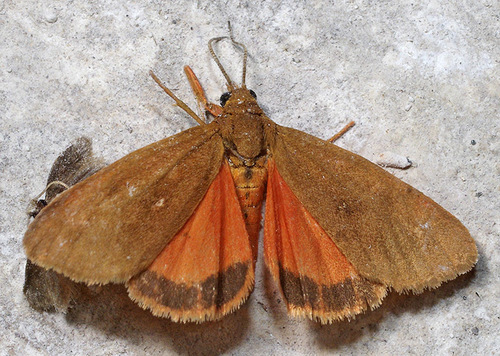


Orange Virbia Moth
virbia aurantiaca
The Orange Virbia Moth (Virbia aurantiaca) is a delightful and vibrant member of the tiger moth subfamily. Known for its striking contrast of colors, this small moth brings a splash of warm orange to the grassy fields and damp meadows of eastern North America. Unlike many moth species that are strictly nocturnal, the Orange Virbia is frequently active during the day and at dusk, fluttering low through vegetation in search of mates or nectar. Its life cycle is deeply intertwined with various common weeds and wildflowers, making it a vital and fascinating contributor to local grassland ecosystems.
生息地: Typically found in damp meadows, grassy fields, marsh edges, and open woodlands where larval host plants are abundant.
This small moth features a wingspan of approximately 2 to 3 centimeters. Its forewings are typically a muted, earthy shade ranging from yellowish-brown to deep cinnamon, which provides excellent camouflage when resting on leaf litter. In stark contrast, its hindwings are a brilliant, fiery orange or peach-colored hue, boldly bordered with dark charcoal-black markings. The abdomen is also bright orange, warning potential predators of its toxic chemical defenses.
カテゴリ
昆虫レア度
Common
危険度
1/5 · 非常に低い
スナップ
最初にスナップしよう!
Male Orange Virbia Moths have highly sensitive antennae that can detect female sex pheromones from extraordinary distances.
Their caterpillars are densely covered in stiff, bristly hairs, giving them a fuzzy appearance often referred to as woolly bears.
When threatened, they flash their bright orange hindwings, a sudden burst of color designed to startle predators.
Emits ultrasonic clicks to warn insectivorous bats of its toxicity and disrupt their echolocation.
Sequesters toxic compounds from host plants during its larval stage, rendering both caterpillar and adult toxic to predators.
Adapts to diurnal and crepuscular flight, utilizing daytime warmth to search for mates and nectar.
Caterpillars feed on various low-growing herbaceous weeds, while adults primarily sip flower nectar or moisture.
年齢による違い: Larvae consume solid plant foliage, whereas adults transition to a liquid diet consisting of nectar and water.
Taraxacum officinale
Larvae feed on the leaves of this common weed.
Plantago major
Larvae graze on the foliage of this broadleaf herb.
Eptesicus fuscus
Preys on adult moths but is often deterred by their ultrasonic clicks.
このオブジェクトにはまだ特徴バッジが割り当てられていません。
まだ別名はありません。
テーマが追加されると、このオブジェクトのコレクションがここに表示されます。
危険度
1/5 · 非常に低い
まだ特別な安全上の注意はありません。
Orange Virbia Mothを識別する最も簡単な方法は、Snappit自然識別アプリを使用することです。
1-2 cm
2-3 cm
0.0001-0.0003 kg
0-1 年
8 km/h
Caterpillars feed on various low-growing herbaceous weeds, while adults primarily sip flower nectar or moisture.
Typically found in damp meadows, grassy fields, marsh edges, and open woodlands where larval host plants are abundant.
ズームインしてクラスターを分割し、このオブジェクトが撮影された場所を探索しましょう。
新しい観察が追加されると、ここに最近のスナップが表示されます。




_and_eggs%2C_Natchez_Trace%2C_Natchez%2C_Mississippi.jpg&width=800)




.jpg&width=800)






