

Oregon Spikemoss
selaginella oregana
Oregon Spikemoss (Selaginella oregana) is a fascinating, moss-like vascular plant that drapes the moist forests of the Pacific Northwest in lush, green curtains. Unlike true mosses, this unique lycophyte possesses a primitive vascular system to transport water and nutrients, making it an evolutionary bridge between lower plants and ferns. It thrives primarily as an epiphyte, hanging in soft, cascading mats from the branches of deciduous trees, particularly bigleaf maples, in humid coastal rainforests. In these misty habitats, Oregon Spikemoss plays a vital ecological role by intercepting rainfall, maintaining high local humidity, and providing microhabitats for canopy-dwelling invertebrates. Its ability to survive dry spells by entering a dormant state and quickly reviving with the rain highlights its remarkable resilience. Spotting this delicate, pendulous plant dangling from moss-draped branches is a quintessential experience of the Pacific Northwest wilderness.
生息地: Found hanging from tree branches or carpeting wet rocks in the mossy, temperate rainforests of the Pacific Northwest.
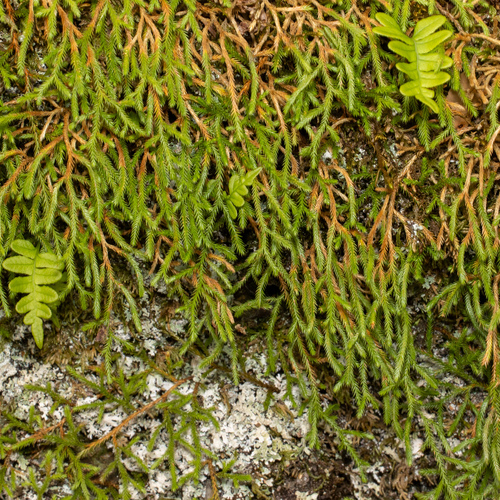
Oregon Spikemoss forms long, pendulous, light-green to yellow-green mats of slender, dichotomously branching stems that can reach up to 90 centimeters in length. The stems are densely covered in tiny, overlapping, scale-like leaves (microphylls) that are linear-lanceolate, soft, and lack a prominent spine at the tip. During the reproductive phase, it develops inconspicuous, four-sided, spore-bearing cones called strobili at the tips of its branches, which blend seamlessly with the foliage.
カテゴリ
植物レア度
Common
危険度
1/5 · 非常に低い
スナップ
最初にスナップしよう!
Despite its mossy appearance and name, Oregon Spikemoss is a vascular lycophyte, placing it closer on the evolutionary tree to ferns than to actual mosses.
It is one of the few spikemosses in temperate regions that has adapted to a completely epiphytic lifestyle, living entirely off the ground on tree limbs.
The species is highly sensitive to humidity levels; in dry summer conditions, its soft branches can look limp and dry, but they spring back to vibrant life with the first rain.
It successfully grows high above the forest floor on tree limbs, giving it better access to light and moist air.
It can withstand periods of dry weather by rolling its leaves and slowing metabolic activity, recovering instantly when moisture returns.
It combines ancient spore-based reproduction with a primitive vascular network, allowing efficient nutrient distribution over long hanging strands.
As a photoautotroph, Oregon Spikemoss produces its own energy through photosynthesis, utilizing sunlight, carbon dioxide, and ambient moisture.
Acer macrophyllum
Grows epiphytically on the moss-covered branches of this deciduous tree host.
Isothecium myosuroides
Competes for moisture, space, and light on the branches of coastal rainforest trees.
Picea sitchensis
Occasionally colonizes the bark of this large, evergreen conifer in wet coastal sites.
このオブジェクトにはまだ特徴バッジが割り当てられていません。
まだ別名はありません。
テーマが追加されると、このオブジェクトのコレクションがここに表示されます。
危険度
1/5 · 非常に低い
まだ特別な安全上の注意はありません。
Oregon Spikemossを識別する最も簡単な方法は、Snappit自然識別アプリを使用することです。
10-90 cm
0.01-0.25 kg
As a photoautotroph, Oregon Spikemoss produces its own energy through photosynthesis, utilizing sunlight, carbon dioxide, and ambient moisture.
Found hanging from tree branches or carpeting wet rocks in the mossy, temperate rainforests of the Pacific Northwest.
ズームインしてクラスターを分割し、このオブジェクトが撮影された場所を探索しましょう。
新しい観察が追加されると、ここに最近のスナップが表示されます。









_001.jpg&width=800)









