

Pa'Iniu
astelia argyrocoma
Pa'Iniu (Astelia argyrocoma) is a striking, silver-sheened perennial herb endemic to the wet, high-elevation forests and bogs of Kauai, Hawaii. Growing both on the forest floor and high up in the mossy canopy as an epiphyte, this plant is an iconic component of the Alakai Wilderness Preserve. Its long, sword-like leaves are renowned for their brilliant, reflective coating of microscopic silvery scales, which help it thrive in the misty, high-UV mountain environment. Historically, Native Hawaiians highly valued the shimmering leaves of the pa'iniu, carefully weaving them into beautiful lei and utilizing them for traditional ornamentation. Today, it remains a vital ecological anchor in its native ecosystem, providing structure, moisture retention, and food for a variety of unique Hawaiian forest birds and insects.
生息地: Found in high-elevation montane wet forests and bogs, often growing epiphytically on mossy branches of trees.
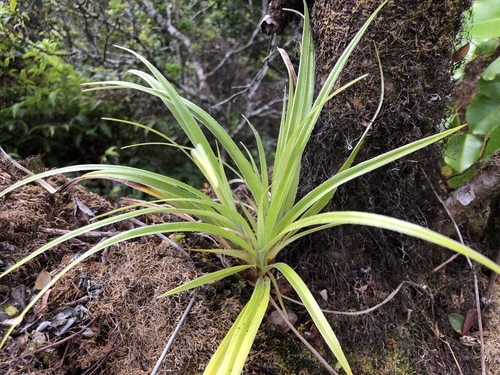
This plant is easily recognized by its dense, rosette-forming clump of long, sword-shaped leaves that grow up to 120 cm in length. The upper surfaces of the leaves are a soft green, but the undersides and margins are heavily coated in dense, appressed scales that shimmer with a brilliant, metallic silver or gold hue. When in bloom, it produces small, inconspicuous clusters of greenish-white flowers on a central stalk, which later mature into fleshy orange or yellow berries that stand out brightly against the metallic foliage.
カテゴリ
植物レア度
Common
危険度
1/5 · 非常に低い
スナップ
最初にスナップしよう!
Despite its grass-like or bromeliad-like appearance, the pa'iniu actually belongs to the family Asteliaceae, which is closely related to asparagus.
Its scientific species name, argyrocoma, literally translates to 'silver-haired', referring to the dense, shimmering scales on its leaves.
The reflective silvery scales on the leaves were traditionally stripped by Native Hawaiians and woven into lei to create a striking, sparkling effect.
The dense layer of microscopic scales on its leaves acts as a highly reflective shield, protecting the plant from intense high-elevation solar radiation.
It can grow without soil, anchoring itself to mossy tree branches and absorbing moisture and nutrients directly from the humid air and organic debris.
The rosette arrangement of its V-shaped leaves is perfectly designed to channel rainfall and heavy mist directly down to the plant's base, ensuring constant hydration.
As a photosynthetic plant, it utilizes chlorophyll and sunlight to convert carbon dioxide and water into vital sugars and energy.
Metrosideros polymorpha
Grows epiphytically on the trunk and branches of this native Hawaiian tree, utilizing it as physical support.
Myadestes palmeri
The fleshy orange berries of the pa'iniu serve as an important food source for this critically endangered native thrush.
Hedychium gardnerianum
Competes for space and nutrients on the forest floor and tree trunks with this aggressive, invasive ginger plant.
このオブジェクトにはまだ特徴バッジが割り当てられていません。
まだ別名はありません。
テーマが追加されると、このオブジェクトのコレクションがここに表示されます。
危険度
1/5 · 非常に低い
まだ特別な安全上の注意はありません。
Pa'Iniuを識別する最も簡単な方法は、Snappit自然識別アプリを使用することです。
30-120 cm
0.5-4 kg
10-40 年
As a photosynthetic plant, it utilizes chlorophyll and sunlight to convert carbon dioxide and water into vital sugars and energy.
Found in high-elevation montane wet forests and bogs, often growing epiphytically on mossy branches of trees.
ズームインしてクラスターを分割し、このオブジェクトが撮影された場所を探索しましょう。
新しい観察が追加されると、ここに最近のスナップが表示されます。