

Palenose Parrotfish
scarus psittacus
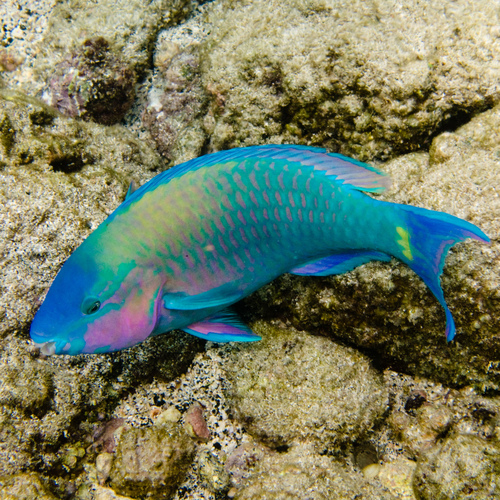
The Palenose Parrotfish (Scarus psittacus) is a vibrant and ecologically vital marine fish found throughout the tropical waters of the Indo-Pacific. Operating as one of the key caretakers of coral reefs, this species spends its days scraping algae from dead coral skeletons, preventing the algae from smothering the delicate live corals. They undergo a fascinating life cycle characterized by sequential hermaphroditism, starting as females in their initial phase before the dominant individuals transition into brilliantly colored terminal phase males. This species is highly social and often seen grazing in mixed-species schools, contributing directly to the production of white sand through their unique digestive process.
生息地: Found in shallow, sunlit coral reefs, lagoons, and seaward reef slopes rich in coral growth.
The Palenose Parrotfish is characterized by its robust, compressed body and a distinct beak-like mouth formed by fused teeth. Its appearance changes dramatically between life phases: initial phase individuals are typically muted reddish-brown or greyish with pale noses, while terminal phase males showcase a stunning array of blue-green, pink, and yellow hues on their scales, with a prominent pale green or yellowish patch on their snout. They typically reach a maximum length of around 30 centimeters.
カテゴリ
魚類レア度
Common
危険度
1/5 · 非常に低い
スナップ
最初にスナップしよう!
At night, they sleep inside a self-made mucus bubble that acts as a protective shield against predators and parasites.
Palenose parrotfish are protogynous hermaphrodites, meaning they all start life as females, but can change into males if the harem's dominant male dies.
The sand on tropical beaches is largely composed of parrotfish poop, which is the crushed coral skeleton they excrete after digesting the algae.
Fused teeth forming a powerful beak capable of scraping tough algae directly off carbonate rock surfaces.
Secretes a transparent envelope of mucus at night to mask its scent from nocturnal predators.
Can transition from a female to a highly colorful dominant male in response to social group dynamics.
Feeds primarily by grazing on benthic algae and associated microflora scraped from rocks and dead coral bases.
年齢による違い: Juveniles feed on smaller, softer algal films, while adults graze on tougher substrates using stronger jaws.
Acropora cervicornis
Grazes on the algae that grows on dead branches of this coral, keeping the reef clean.
Gymnothorax javanicus
Hunted by this reef predator during both day and night encounters.
Acanthurus triostegus
Competes with other grazing herbivorous fish for feeding territory on the reef flat.
このオブジェクトにはまだ特徴バッジが割り当てられていません。
まだ別名はありません。
テーマが追加されると、このオブジェクトのコレクションがここに表示されます。
危険度
1/5 · 非常に低い
まだ特別な安全上の注意はありません。
Palenose Parrotfishを識別する最も簡単な方法は、Snappit自然識別アプリを使用することです。
Feeds primarily by grazing on benthic algae and associated microflora scraped from rocks and dead coral bases.
Found in shallow, sunlit coral reefs, lagoons, and seaward reef slopes rich in coral growth.
Grazing
ズームインしてクラスターを分割し、このオブジェクトが撮影された場所を探索しましょう。
新しい観察が追加されると、ここに最近のスナップが表示されます。