

Panama Grass Tubeworm Moth
acrolophus panamae
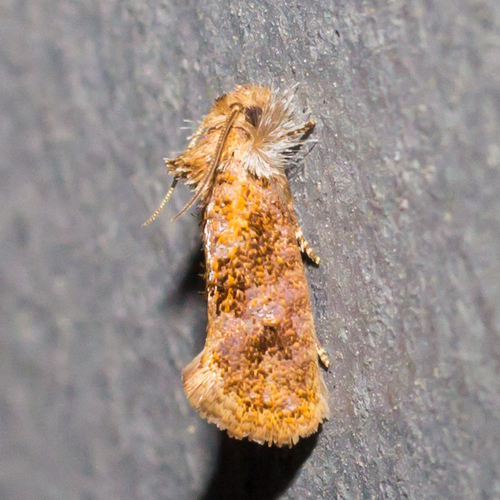
The Panama Grass Tubeworm Moth (Acrolophus panamae) is a fascinating member of the moth world, earning its peculiar name from the remarkable architectural skills of its caterpillars. Instead of roaming freely on host plants, the larvae construct elaborate, protective silken tubes in the soil and amongst grass roots, which they reinforce with dirt, frass, and plant debris. These hidden subterranean galleries allow them to safely forage for roots and decaying organic matter away from the prying eyes of predators. As adults, these moths are robust and uniquely textured, often appearing as though they are wearing thick, furry coats. While they might not boast the dazzling colors of some diurnal Lepidopterans, their exceptional larval adaptations and vital role in nutrient cycling make them an important part of Central American grassland ecosystems. Spotting an adult resting near grassy habitats is a treat for naturalists, offering a glimpse into the secretive, intricate lives of the Neotropics' tubeworm moths.
生息地: Primarily found in Central American grasslands, savannas, and forest edges where abundant grass roots and detritus provide ideal conditions for larval tube-building.
Adult Panama Grass Tubeworm Moths are stout-bodied insects with a distinctive "furry" appearance. They typically feature mottled, earth-toned wings in shades of brown, tan, and grayish-black, which they hold in a steep, tent-like fashion over their abdomens when resting. One of their most notable visual characteristics is their elongated, densely scaled labial palpi, which curve upward and give the moth a pronounced "snout" or a tufted crest on its head. Females are generally larger and heavier than males. Their wingspan usually ranges from 1 to 3 centimeters, a size and color palette that allows them to blend perfectly into the bark and dead leaves of their woodland and grassland habitats.
カテゴリ
昆虫レア度
Common
危険度
1/5 · 非常に低い
スナップ
最初にスナップしよう!
Adult Acrolophus moths have uniquely elongated palpi on their faces, giving them a distinctively 'snout-like' appearance or making them look like they have a furry pompadour.
Because the adults do not feed, their sole purpose is to find a mate and reproduce before their brief adult lifespan of just a week or two comes to an end.
The 'tubeworm' in their name comes from the caterpillars' habit of building tough, silk-lined tubes in the soil, which superficially resemble the casings of marine tubeworms.
When disturbed, the caterpillars can quickly retreat backward deep into their subterranean tubes to escape predators like ants and beetles.
Larvae construct complex, silk-lined tubular galleries in the soil and grass root systems, weaving in dirt and frass for camouflage and protection.
Adults possess heavily textured, mottled brown wings that perfectly mimic dead leaves and rough bark, allowing them to remain virtually invisible to diurnal predators.
The larvae possess robust mandibles adapted for chewing tough grass roots and decaying plant matter, playing an essential role in cycling nutrients back into the soil.
The larvae feed primarily on the roots of grasses and decaying plant material found near the soil surface, while adults typically do not feed.
年齢による違い: Adults possess reduced mouthparts and typically do not feed, relying entirely on energy reserves gathered during their larval stage.
Molossus molossus
Bats frequently hunt these nocturnal moths on the wing during the night.
Cynodon dactylon
Larvae feed extensively on the roots of common tropical and subtropical grasses.
Calosoma spp.
Ground beetles often prey upon the larvae if they breach their protective silken tubes.
このオブジェクトにはまだ特徴バッジが割り当てられていません。
まだ別名はありません。
テーマが追加されると、このオブジェクトのコレクションがここに表示されます。
危険度
1/5 · 非常に低い
まだ特別な安全上の注意はありません。
Panama Grass Tubeworm Mothを識別する最も簡単な方法は、Snappit自然識別アプリを使用することです。
1-2 cm
1-3 cm
0.0001-0.0005 kg
The larvae feed primarily on the roots of grasses and decaying plant material found near the soil surface, while adults typically do not feed.
Primarily found in Central American grasslands, savannas, and forest edges where abundant grass roots and detritus provide ideal conditions for larval tube-building.
Foraging
50-200
ズームインしてクラスターを分割し、このオブジェクトが撮影された場所を探索しましょう。
新しい観察が追加されると、ここに最近のスナップが表示されます。