

Papillose Peatmoss
sphagnum papillosum
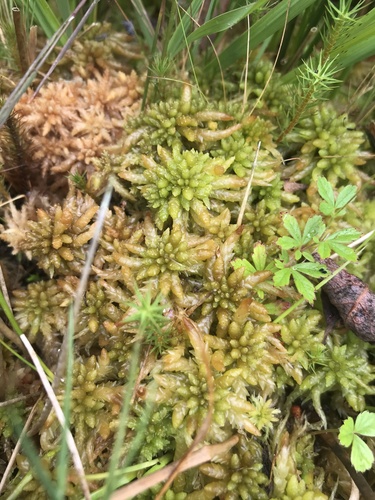
Papillose Peatmoss (Sphagnum papillosum) is a structurally complex and ecologically vital species of peat moss that plays a key role in building and maintaining peatland ecosystems. This remarkable bryophyte is characterized by its chunky, robust growth form and its rich, warm coloration that often paints bogs in shades of golden-brown and ochre. Unlike many other mosses, it thrives in extremely nutrient-poor, acidic environments where it acts as a primary habitat engineer. By accumulating thick mats of slowly decaying organic matter, Papillose Peatmoss is a fundamental component of peat bogs, which serve as crucial global carbon sinks. Its exceptional capacity to retain water helps regulate local hydrology, keeping wetlands damp even during dry spells, which makes it an indispensable guardian of temperate and boreal wetland systems. For naturalists and wetland observers, encountering a lush, golden carpet of Papillose Peatmoss is a sign of a healthy, mature bog ecosystem.
生息地: Found in wet, nutrient-poor acid peatlands, particularly in raised bogs, blanket mires, and poor fens.
This species is distinguished by its robust, pale-green to golden-brown or ochre-colored carpets and hummocks. Individual plants have stout, club-like branches that cluster tightly at the head, giving the moss a compact and chunky appearance. Under magnification, the outer cells of the stems and branch leaves exhibit microscopic, nipple-like bumps called papillae, which give the species its scientific name. The leaves are broad and boat-shaped, overlapping tightly along the branches. It lacks a true root system, instead growing in dense, continuous mats where only the top few centimeters are actively growing, while the lower portions slowly turn into peat.
カテゴリ
植物レア度
Common
危険度
1/5 · 非常に低い
スナップ
最初にスナップしよう!
Due to its natural acidity and exceptional water retention, Sphagnum moss was used as an antiseptic wound dressing during World War I.
Its species name, papillose, comes from the microscopic, nipple-like bumps on the inner walls of its leaf cells.
Sphagnum peatlands store more carbon than all of the world's tropical rainforests combined, making species like Papillose Peatmoss crucial for climate regulation.
Can absorb and hold up to 20 times its dry weight in water within specialized, empty hyaline cells.
Actively pumps hydrogen ions into its surroundings, lowering the pH to create an acidic environment that inhibits competitors and decomposers.
Creates highly acidic, anaerobic conditions that stall the decay of organic material, locking away carbon for thousands of years.
As a photoautotrophic plant, it produces its own energy via photosynthesis, absorbing water and mineral nutrients directly from the air and precipitation.
Sarracenia purpurea
Provides a wet, acidic substrate necessary for the carnivorous plant to grow.
Eriophorum vaginatum
Competes for space and sunlight in nutrient-poor acidic peat bogs.
このオブジェクトにはまだ特徴バッジが割り当てられていません。
まだ別名はありません。
テーマが追加されると、このオブジェクトのコレクションがここに表示されます。
危険度
1/5 · 非常に低い
まだ特別な安全上の注意はありません。
Papillose Peatmossを識別する最も簡単な方法は、Snappit自然識別アプリを使用することです。
520+ cm
As a photoautotrophic plant, it produces its own energy via photosynthesis, absorbing water and mineral nutrients directly from the air and precipitation.
Found in wet, nutrient-poor acid peatlands, particularly in raised bogs, blanket mires, and poor fens.
Photosynthesis
ズームインしてクラスターを分割し、このオブジェクトが撮影された場所を探索しましょう。
新しい観察が追加されると、ここに最近のスナップが表示されます。