

Paradoxosomatinae
paradoxosomatinae
Paradoxosomatinae is a diverse and widespread subfamily of millipedes, belonging to the order Polydesmida. These fascinating arthropods are crucial decomposers in terrestrial ecosystems, playing a vital role in nutrient cycling by breaking down dead organic matter. Often overlooked due to their cryptic nature, they represent a significant component of soil invertebrate communities across various biomes. Their segmented bodies and often subtle colorations belie a complex life adapted to humid, dark environments, making them intriguing subjects for closer observation.
生息地: Found predominantly in moist, dark environments rich in decaying organic matter, such as leaf litter, under logs, beneath stones, and within soil layers.
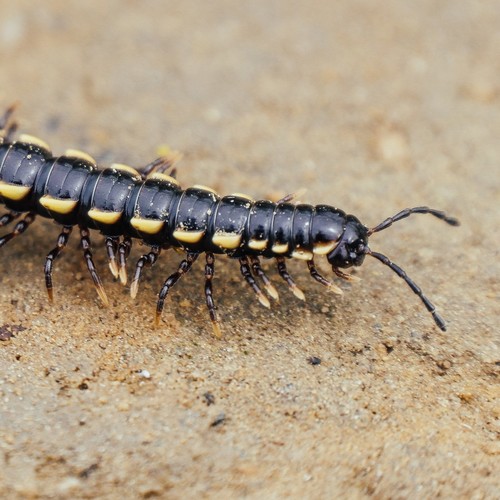
Paradoxosomatinae millipedes typically exhibit a flattened or sub-cylindrical body shape, characterized by numerous segments, usually ranging from 18 to 20. Their coloration commonly includes shades of brown, black, or reddish-brown, sometimes featuring contrasting lighter keels (lateral paranota) along the sides, which can be yellowish or orange. Sizes generally vary from 1 to 5 centimeters in length, with a smooth, often glossy exoskeleton. They lack wings and move with a characteristic wave-like motion of their many legs.
カテゴリ
Animalレア度
Common
危険度
1/5 · 非常に低い
スナップ
最初にスナップしよう!
Despite their name "millipede" (meaning "thousand feet"), no known species actually has 1,000 legs; Paradoxosomatinae typically have around 36-40 segments, each with two pairs of legs.
Some species within this subfamily can release a pungent, bitter-tasting liquid from glands along their body when disturbed, acting as an effective deterrent against predators.
Their segmented bodies are highly adapted for pushing through soil and leaf litter, with a strong, flexible exoskeleton providing protection.
They are critical "engineers" of the soil, helping to aerate it and break down organic matter into smaller particles, making nutrients available for plants.
Many species in this subfamily possess ozopores, glands along their sides that secrete defensive chemicals, often hydrogen cyanide or quinones, to deter predators.
They are highly efficient detritivores, breaking down dead plant material like leaves and wood, thus recycling nutrients back into the ecosystem.
Their flattened bodies allow them to easily burrow into soil, hide under debris, and navigate tight spaces, protecting them from predators and desiccation.
Paradoxosomatinae millipedes primarily feed on decaying plant material, fungi, and the associated microorganisms found in their habitat. They play a crucial role in breaking down organic matter.
Fungi
Consumes decaying organic matter, including fungal hyphae and spores.
Staphylinidae
Predators that feed on millipedes, often found in the same microhabitats.
Plant detritus
Relies on the availability of fallen leaves and other plant debris as both food source and shelter.
Various Passeriformes
These millipedes are preyed upon by various insectivorous birds.
このオブジェクトにはまだ特徴バッジが割り当てられていません。
まだ別名はありません。
テーマが追加されると、このオブジェクトのコレクションがここに表示されます。
危険度
1/5 · 非常に低い
まだ特別な安全上の注意はありません。
Paradoxosomatinaeを識別する最も簡単な方法は、Snappit自然識別アプリを使用することです。
1-5 cm
0.001-0.005 kg
2-5 年
Paradoxosomatinae millipedes primarily feed on decaying plant material, fungi, and the associated microorganisms found in their habitat. They play a crucial role in breaking down organic matter.
Found predominantly in moist, dark environments rich in decaying organic matter, such as leaf litter, under logs, beneath stones, and within soil layers.
Foraging
20-100
ズームインしてクラスターを分割し、このオブジェクトが撮影された場所を探索しましょう。
新しい観察が追加されると、ここに最近のスナップが表示されます。



