

Parry'S Nolina
nolina parryi
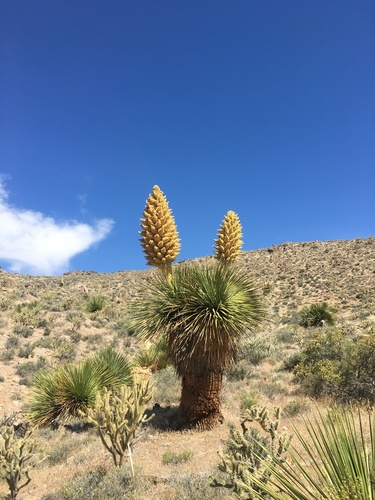
Parry's Nolina, also known as Parry's beargrass, is a striking, evergreen succulent-like plant native to the arid mountain slopes and high desert regions of the southwestern United States and northern Mexico. Though it closely resembles a yucca or agave with its dense rosettes of long, sword-like leaves, it belongs to the Asparagaceae family. This resilient plant is celebrated for its ability to thrive in extremely harsh, rocky soils where few other large plants can survive, forming dramatic focal points in the desert landscape.
生息地: Found on dry, rocky slopes, chaparral, and pinyon-juniper woodlands in desert mountain ranges.
This species forms a large, rounded clump of stiff, fibrous, blue-green leaves that grow up to 1.5 meters long, featuring finely serrated margins. When mature, it sends up a colossal woody flower stalk reaching 2 to 4 meters in height, topped with a dense, creamy-white panicle containing thousands of tiny, star-shaped flowers that bloom in late spring.
カテゴリ
植物レア度
Common
危険度
1/5 · 非常に低い
スナップ
最初にスナップしよう!
Despite its common name 'beargrass' and grass-like appearance, it is a distant relative of garden asparagus.
Indigenous peoples of the American Southwest used the strong, fibrous leaves of this plant to weave highly durable baskets, mats, and sandals.
The spectacular flowering event does not kill the plant, unlike many agave species which die after blooming once.
Features a thick, woody underground caudex that allows the plant to quickly resprout and regenerate even after intense desert wildfires.
The concave, channeled structure of its stiff leaves efficiently funnels minimal rainfall directly down to its centralized root system.
The margins of the leaves are lined with microscopic, razor-sharp teeth that deter herbivores from grazing on its tough foliage.
As a photosynthetic plant, it manufactures its own food using sunlight, water, and carbon dioxide while absorbing essential desert minerals through its roots.
Ovis canadensis nelsoni
The young, tender flowering stalks provide highly nutritious food for desert bighorn sheep during the spring.
Neotoma lepida
Desert woodrats collect the sharp, fibrous leaves to build protective, predator-proof middens and nests.
Apis mellifera
Provides critical nectar and pollen to native desert bees, which assist in cross-pollinating the plants.
このオブジェクトにはまだ特徴バッジが割り当てられていません。
まだ別名はありません。
テーマが追加されると、このオブジェクトのコレクションがここに表示されます。
危険度
1/5 · 非常に低い
まだ特別な安全上の注意はありません。
Parry'S Nolinaを識別する最も簡単な方法は、Snappit自然識別アプリを使用することです。
100-400 cm
50-100 年
As a photosynthetic plant, it manufactures its own food using sunlight, water, and carbon dioxide while absorbing essential desert minerals through its roots.
Found on dry, rocky slopes, chaparral, and pinyon-juniper woodlands in desert mountain ranges.
ズームインしてクラスターを分割し、このオブジェクトが撮影された場所を探索しましょう。
新しい観察が追加されると、ここに最近のスナップが表示されます。














