

Peelbark St. John'S Wort
hypericum fasciculatum
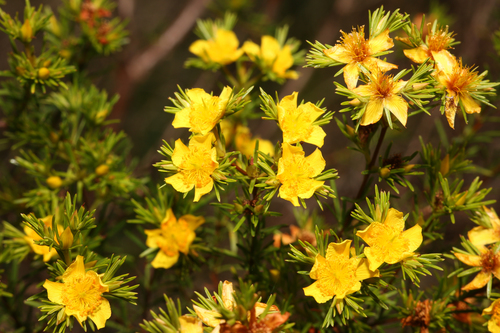
The Peelbark St. John's Wort (Hypericum fasciculatum) is an eye-catching, woody shrub native to the wetlands and seasonal ponds of the southeastern United States. Thriving in acidic, boggy soils, this resilient plant is easily recognized by its distinctive, papery bark that peels away in thin, reddish-brown sheets from older stems. During its peak blooming season, it produces a profusion of bright yellow flowers with dense clusters of bushy stamens, creating a stunning contrast against its dark green, needle-like foliage. This species plays an important role in its wetland ecosystems, acting as a stabilizer for shorelines and a critical pollen source for native bees and other pollinators.
生息地: Found in seasonal wetlands, cypress dome margins, wet pine flatwoods, and boggy depressions in the southeastern United States.
This woody, multi-branched shrub typically grows 60 to 200 centimeters tall. Its most prominent features are its peeling, coppery-orange to reddish-brown bark and its narrow, pine-like leaves that grow in dense, tight clusters along the stems. The flowers, about 1.5 to 2.5 cm wide, feature five bright yellow petals surrounding a prominent, explode-of-fireworks cluster of numerous yellow stamens.
カテゴリ
植物レア度
Common
危険度
1/5 · 非常に低い
スナップ
最初にスナップしよう!
Despite being a wetland plant, its needle-like leaves resemble those of desert plants, an adaptation to survive periods when the sandy soils dry out completely.
The bright yellow flowers lack nectar, so they attract pollinators solely by offering massive quantities of pollen from their numerous stamens.
The common name 'Peelbark' comes from its highly distinctive bark, which continuously flakes off in papery, thin sheets to reveal fresh layers beneath.
Sheds its outer bark layers continuously to deter climbing vines, epiphytes, and potential pests while offering mild fire resistance.
Possesses specialized root adaptations that allow it to survive in oxygen-depleted, waterlogged soils for months at a time.
Features tightly clustered, needle-like leaves that reduce surface area and limit water loss during dry seasonal spells.
As a photoautotrophic plant, it produces its own energy through photosynthesis, utilizing sunlight, carbon dioxide, and nutrients absorbed from wet, acidic soils.
Bombus pennsylvanicus
Collects pollen from the abundant stamens of the flowers, aiding in pollination.
Odocoileus virginianus
May occasionally browse on the leaves and tender woody shoots during winter.
Taxodium distichum
Often grows in the understory or shallow margins of cypress dome habitats dominated by this tree.
このオブジェクトにはまだ特徴バッジが割り当てられていません。
まだ別名はありません。
テーマが追加されると、このオブジェクトのコレクションがここに表示されます。
危険度
1/5 · 非常に低い
まだ特別な安全上の注意はありません。
Peelbark St. John'S Wortを識別する最も簡単な方法は、Snappit自然識別アプリを使用することです。
60-200 cm
5-20 年
As a photoautotrophic plant, it produces its own energy through photosynthesis, utilizing sunlight, carbon dioxide, and nutrients absorbed from wet, acidic soils.
Found in seasonal wetlands, cypress dome margins, wet pine flatwoods, and boggy depressions in the southeastern United States.
ズームインしてクラスターを分割し、このオブジェクトが撮影された場所を探索しましょう。
新しい観察が追加されると、ここに最近のスナップが表示されます。