

Peridot Sweat Bee
augochlorella pomoniella
The Peridot Sweat Bee (Augochlorella pomoniella) is a dazzling, emerald-green jewel of the insect world. Native to western North America, this tiny native bee is a member of the sweat bee family, Halictidae, famous for their unusual attraction to the salts found in human perspiration. Far from being pests, these bees are incredibly valuable, hard-working native pollinators that help sustain local ecosystems, wild habitats, and backyard gardens alike. These fascinating insects display flexible social behaviors, transitioning between solitary nesting and small, cooperative colonies depending on environmental conditions, climate, and geographic location. They construct intricate burrows in bare soil or rotting wood, where females raise their young. Watching a Peridot Sweat Bee zip from flower to flower is a magical experience, as their metallic bodies glint like polished gemstones under the bright summer sun.
生息地: Found in open meadows, coastal chaparral, suburban gardens, and forest edges where sunny patches of bare soil and abundant wildflowers are present.
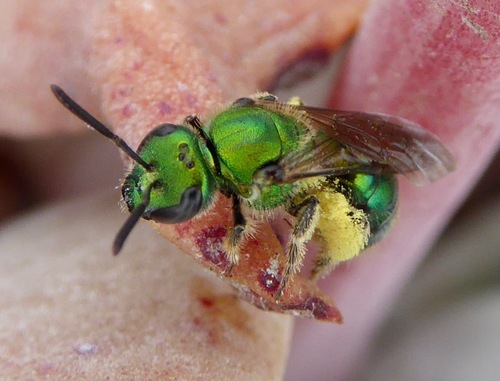
This diminutive bee measures around 7 to 9 millimeters in length and is immediately recognizable by its striking, brilliant metallic-green or golden-green exoskeleton that shimmers intensely in the sunlight. The abdomen is slightly flattened, and the face features large, dark compound eyes. Females possess specialized pollen-carrying hairs (scopae) on their hind legs, which often appear heavily dusted with bright yellow pollen. Their wings are translucent with delicate venation, beating at rapid speeds to produce a high-pitched, subtle hum.
カテゴリ
昆虫レア度
Common
危険度
1/5 · 非常に低い
スナップ
最初にスナップしよう!
Their intense metallic color is a form of physical structural coloration, which means their brilliant shine won't fade even long after they have died.
They are excellent buzz pollinators, using rapid muscle vibrations to shake pollen free from flowers that other bees struggle to pollinate.
While females can sting if squeezed or stepped on, their sting is incredibly mild and often described as a tiny, brief prick.
Their shimmering metallic-green hue is created by microscopic physical structures on their exoskeleton that refract light, rather than chemical pigments.
They possess highly sensitive receptors to detect and consume mammalian sweat, which provides them with vital sodium and moisture.
Females use their strong mandibles and legs to excavate waterproof subterranean nests, coating the cells with a self-produced waxy secretion.
Adults feed on energy-rich nectar, while collecting protein-dense pollen to provision their subterranean nests for developing larvae.
年齢による違い: Larvae consume a baked pollen loaf mixed with nectar provided by their mother, while adults feed directly on nectar from flowers.
Eschscholzia californica
Provides essential pollination services while gathering pollen and nectar.
Philanthus triangulum
Preys upon foraging adult bees to provision its own nest.
Sphecodes monilicornis
Lays its eggs in the nests of the sweat bee, consuming the host's food provisions.
このオブジェクトにはまだ特徴バッジが割り当てられていません。
まだ別名はありません。
テーマが追加されると、このオブジェクトのコレクションがここに表示されます。
危険度
1/5 · 非常に低い
まだ特別な安全上の注意はありません。
Peridot Sweat Beeを識別する最も簡単な方法は、Snappit自然識別アプリを使用することです。
1 cm
1-2 cm
0.00001-0.00003 kg
1 年
15 km/h
Adults feed on energy-rich nectar, while collecting protein-dense pollen to provision their subterranean nests for developing larvae.
Found in open meadows, coastal chaparral, suburban gardens, and forest edges where sunny patches of bare soil and abundant wildflowers are present.
ズームインしてクラスターを分割し、このオブジェクトが撮影された場所を探索しましょう。
新しい観察が追加されると、ここに最近のスナップが表示されます。

















