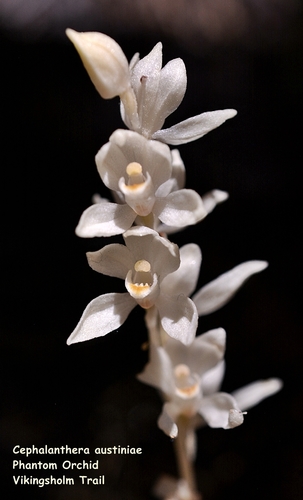


Phantom Orchid
cephalanthera austiniae
The Phantom Orchid (Cephalanthera austiniae) is one of nature's most hauntingly beautiful anomalies. Lacking chlorophyll entirely, this ghostly white wildflower does not engage in photosynthesis. Instead, it lives as a mycoheterotroph, obtaining all of its organic nutrients from a symbiotic underground fungal network. It arises from the dark forest floor like an ethereal specter, shining brightly against the damp, decaying leaf litter of mature coniferous forests. Because of its absolute reliance on complex underground ecosystems, the Phantom Orchid is incredibly sensitive to environmental disturbances. It is a true symbol of old-growth forest health, showcasing the intricate, invisible webs of life that exist beneath the soil. Finding one in the wild is a rare and magical experience for any nature enthusiast.
生息地: Found in dense, mature coniferous or mixed forests of western North America, typically growing in deep, damp leaf litter and shade.
This orchid is immediately recognizable by its striking, completely snow-white to cream-colored coloration, containing no green parts whatsoever. Its erect stems grow to a height of 20 to 65 centimeters and are sheathed in paper-like, reduced white leaves. The inflorescence holds 5 to 20 fragrant white flowers, each featuring a distinct yellow or gold patch inside the throat of the lower lip petal.
カテゴリ
植物レア度
Common
危険度
1/5 · 非常に低い
スナップ
最初にスナップしよう!
Because it has no green leaves, early botanists mistakenly classified it as a fungus rather than a flowering plant.
Despite being completely white, its flowers produce a pleasant, sweet scent to attract wild insect pollinators.
It is the only species in the genus Cephalanthera that is entirely native to North America.
Obtains all carbon and nutrients by parasitizing underground mycorrhizal fungi rather than through photosynthesis.
Lacks chlorophyll completely, enabling it to thrive in deep forest floors with near-zero sunlight.
Can survive underground for several years without producing stems or flowers, emerging only when conditions are ideal.
Relies entirely on absorbing organic carbon and nutrients from soil fungi that are associated with the roots of nearby trees.
Pseudotsuga menziesii
The orchid indirectly drains nutrients from this tree's roots via shared underground fungal networks.
Thelephora terrestris
The orchid parasitizes this mycorrhizal fungus to absorb carbon and water.
Lasioglossum
These small native bees pollinate the orchid's white flowers in exchange for nectar.
このオブジェクトにはまだ特徴バッジが割り当てられていません。
まだ別名はありません。
テーマが追加されると、このオブジェクトのコレクションがここに表示されます。
危険度
1/5 · 非常に低い
まだ特別な安全上の注意はありません。
Phantom Orchidを識別する最も簡単な方法は、Snappit自然識別アプリを使用することです。
20-65 cm
5-20 年
Relies entirely on absorbing organic carbon and nutrients from soil fungi that are associated with the roots of nearby trees.
Found in dense, mature coniferous or mixed forests of western North America, typically growing in deep, damp leaf litter and shade.
Absorption
ズームインしてクラスターを分割し、このオブジェクトが撮影された場所を探索しましょう。
新しい観察が追加されると、ここに最近のスナップが表示されます。