

Physocephala Burgessi
physocephala burgessi
Physocephala burgessi, commonly known as a thick-headed fly, is a fascinating insect belonging to the family Conopidae. These flies are notable for their unique life cycle, where the larvae develop as internal parasitoids of other insects, primarily bees and wasps. While the adult flies are harmless nectar feeders, their reproductive strategy makes them an interesting component of their ecosystem, playing a role in regulating populations of their hosts. Often mistaken for wasps due to their striking mimicry, Physocephala burgessi are a testament to evolutionary adaptation. Their presence often indicates a healthy population of their host insects, as well as an abundance of flowering plants that provide nectar for the adults. They are an excellent example of the intricate and often hidden relationships within insect communities.
生息地: Found in open, sunny areas such as meadows, gardens, field edges, and open woodlands where host insects and nectar-producing flowers are abundant.
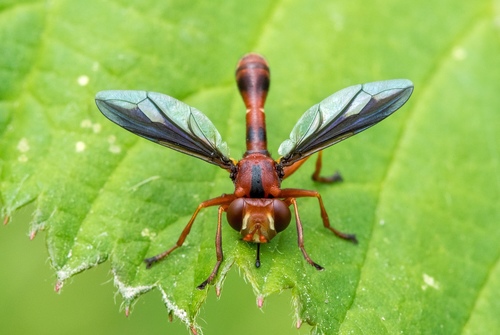
Physocephala burgessi exhibits a distinct wasp-like appearance, a form of Batesian mimicry that helps deter predators. Adults typically have slender, elongated bodies with a predominant black coloration, often adorned with contrasting yellow or reddish-brown markings, particularly on the abdomen. Their heads are relatively large and rounded ('thick-headed'), with prominent eyes. The wings are clear or slightly tinted, often with dark veins, and held in a characteristic manner over the body, further enhancing their resemblance to small wasps. Size-wise, they are medium-small flies, usually measuring between 10-15 mm in body length.
カテゴリ
昆虫レア度
Common
危険度
1/5 · 非常に低い
スナップ
最初にスナップしよう!
Despite their wasp-like appearance, these flies are completely harmless to humans, feeding only on nectar as adults.
Female Physocephala burgessi often lay their eggs on host insects while the host is in flight, requiring incredible precision and timing.
The 'thick-headed' part of their common name refers to the distinctive broad head of flies in the Conopidae family.
The larvae of these flies are endoparasitoids, meaning they live and feed inside their host, eventually leading to the host's death.
Adult Physocephala burgessi closely mimic the appearance of wasps, featuring slender, banded bodies and often a buzzing flight. This mimicry provides protection from predators who avoid stinging insects.
The larval stage of this fly is a highly specialized internal parasitoid. Female flies lay eggs on or inside the bodies of live adult bees and wasps, with the developing larva consuming the host from within.
Adult female flies possess acute sensory abilities to locate suitable host insects, often identifying them in flight. They then swiftly deposit an egg with remarkable precision, ensuring the survival of their offspring.
Adult Physocephala burgessi feed exclusively on nectar from various flowering plants, providing them with energy. In contrast, their larvae are obligate internal parasitoids, developing by consuming the tissues of their living insect hosts.
年齢による違い: Yes, adults are nectar-feeders, while larvae are internal parasitoids of other insects.
Helianthus annuus
Adults feed on nectar from various flowering plants.
Bombus impatiens
Larvae parasitize and develop inside the bodies of various bee species.
Sphex ichneumoneus
Larvae also parasitize various solitary wasp species.
Sayornis phoebe
Adult flies are occasionally preyed upon by insectivorous birds.
このオブジェクトにはまだ特徴バッジが割り当てられていません。
まだ別名はありません。
テーマが追加されると、このオブジェクトのコレクションがここに表示されます。
危険度
1/5 · 非常に低い
まだ特別な安全上の注意はありません。
Physocephala Burgessiを識別する最も簡単な方法は、Snappit自然識別アプリを使用することです。
10-15 cm
18-25 cm
0.00005-0.0001 kg
Adult Physocephala burgessi feed exclusively on nectar from various flowering plants, providing them with energy. In contrast, their larvae are obligate internal parasitoids, developing by consuming the tissues of their living insect hosts.
Found in open, sunny areas such as meadows, gardens, field edges, and open woodlands where host insects and nectar-producing flowers are abundant.
Foraging (adults), Parasitism (larvae)
100-500
ズームインしてクラスターを分割し、このオブジェクトが撮影された場所を探索しましょう。
新しい観察が追加されると、ここに最近のスナップが表示されます。