

Pot Marigold
calendula officinalis
Pot Marigold, or Calendula officinalis, is a vibrant annual plant cherished for its cheerful, daisy-like flowers and a long history of practical uses. Native to Southern Europe, it has been cultivated for centuries not only for its ornamental appeal but also for its notable medicinal properties and culinary versatility. This resilient herb is a favorite among gardeners for its ease of growth and ability to bloom profusely from spring until the first hard frost, bringing continuous color to beds, borders, and containers. Its adaptability and beneficial attributes make it a fascinating and valuable addition to both natural landscapes and cultivated gardens worldwide.
生息地: Pot Marigolds thrive in sunny locations with well-draining soil, commonly found in cultivated gardens, meadows, disturbed sites, and along roadsides.
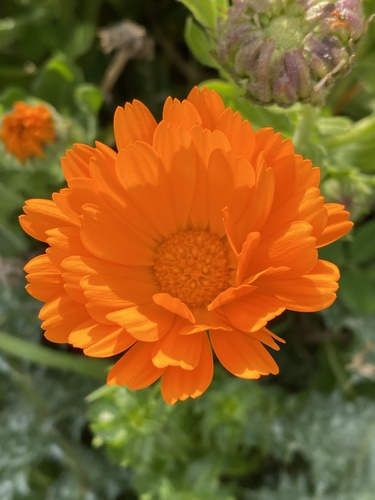
Calendula officinalis features bright orange or yellow flowers, typically 4-7 cm in diameter, with a central disc and numerous ray florets, giving them a distinct daisy or marigold appearance. The flowers are often borne singly or in loose clusters atop sturdy, branched stems. Its leaves are oblong-lanceolate, light green, and slightly hairy, growing alternately along the stem. The plant usually reaches a height of 20 to 60 centimeters, forming a bushy, erect mound.
カテゴリ
植物レア度
Common
危険度
1/5 · 非常に低い
スナップ
最初にスナップしよう!
Historically, Roman soldiers and ancient Greeks used Calendula petals to treat wounds, showcasing its long-standing reputation as a healing herb.
In ancient cultures, Pot Marigold was often used as a dye for fabrics and foods, giving a saffron-like color, earning it the nickname 'poor man's saffron'.
The flowers are known to close up at night or during cloudy weather, reopening with the sun, giving rise to its Latin name 'calendula' which means 'little calendar' or 'throughout the months'.
The unique, curved seeds of the Pot Marigold are adapted for efficient dispersal, often hitchhiking on animal fur or being carried by wind and water.
Calendula is renowned for its anti-inflammatory and antiseptic properties, often used in topical preparations to soothe skin irritations, minor wounds, and burns, promoting faster healing.
The petals of Pot Marigold flowers are edible and possess a mild, slightly peppery flavor. They are frequently used to add color and subtle taste to salads, rice dishes, and as a natural food dye.
When planted near vegetables, Calendula can act as a trap crop for aphids, drawing them away from more valuable plants, and also attracts beneficial pollinators like bees and hoverflies.
As an autotroph, Pot Marigold produces its own food through photosynthesis, converting sunlight into energy. It absorbs essential nutrients and water from the soil through its root system to support growth and development.
Apis mellifera
Pollination for reproduction.
Aphis gossypii
Feeds on plant sap, potentially causing damage.
Coccinella septempunctata
Attracted by Calendula, preys on pests like aphids.
Erysiphe cichoracearum
Pathogen that can infect Calendula plants.
このオブジェクトにはまだ特徴バッジが割り当てられていません。
まだ別名はありません。
テーマが追加されると、このオブジェクトのコレクションがここに表示されます。
危険度
1/5 · 非常に低い
まだ特別な安全上の注意はありません。
Pot Marigoldを識別する最も簡単な方法は、Snappit自然識別アプリを使用することです。
20-60 cm
0.05-0.5 kg
1 年
As an autotroph, Pot Marigold produces its own food through photosynthesis, converting sunlight into energy. It absorbs essential nutrients and water from the soil through its root system to support growth and development.
Pot Marigolds thrive in sunny locations with well-draining soil, commonly found in cultivated gardens, meadows, disturbed sites, and along roadsides.
Photosynthesis And Nutrient Absorption
ズームインしてクラスターを分割し、このオブジェクトが撮影された場所を探索しましょう。
新しい観察が追加されると、ここに最近のスナップが表示されます。