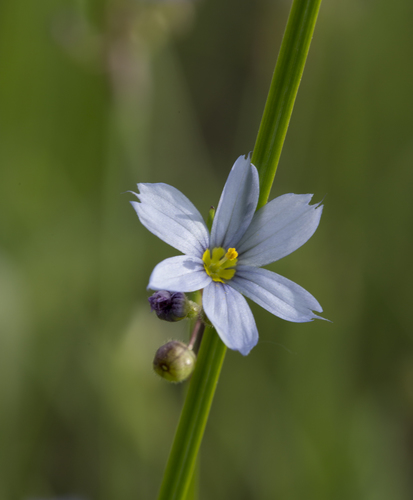


Prairie Blue-Eyed Grass
sisyrinchium campestre
The Prairie Blue-Eyed Grass is a charming, delicate perennial wildflower native to the expansive tallgrass prairies of North America. Despite its deceptive common name and remarkably grass-like foliage, this delightful plant is actually a member of the iris family, Iridaceae. It plays an invaluable ecological role in the early-season prairie environment, providing a vital source of high-quality nectar and pollen for emerging native bees when few other wildflowers have begun to bloom. Gardeners and nature enthusiasts alike cherish this species for its resilient nature and the sudden, brilliant splashes of blue it brings to wild landscapes. It is a true symbol of the North American prairie, capturing the delicate beauty of these threatened grasslands in miniature form.
生息地: Typically found in dry to mesic prairies, limestone glades, sandy savannas, and open woodlands.
This plant features slender, grass-like, light-green leaves that form tidy, erect tufts growing up to 40 cm tall. The small, star-like flowers are about 1 to 1.5 cm wide, possessing six pale blue, lavender, or occasionally pure white tepals. Each flower is highlighted by a bright, golden-yellow center, or 'eye', and grows on flattened, winged stems that closely mimic the appearance of leaves.
カテゴリ
植物レア度
Common
危険度
1/5 · 非常に低い
スナップ
最初にスナップしよう!
Despite its common name and grass-like leaves, it is actually a member of the Iris family (Iridaceae), not a true grass.
Each individual flower of the Prairie Blue-Eyed Grass blooms for only a single day before fading.
Its scientific species name, 'campestre', translates from Latin as 'of the fields' or 'plains', which perfectly describes its preferred wild habitat.
The flowers open only on bright, sunny days, usually mid-morning, and close tightly by afternoon or during cloudy weather to preserve pollen.
Stems are distinctly flattened and winged, allowing them to capture sunlight and perform photosynthesis alongside the leaves to maximize energy production.
Its dense, fibrous root system allows the plant to efficiently absorb moisture and survive in dry, sandy, or rocky prairie soils.
This plant produces its own food using photosynthesis, converting sunlight, water, and carbon dioxide into energy.
Lasioglossum imitatum
Small sweat bees visit the flowers to gather pollen and nectar, acting as key pollinators.
Microtus pennsylvanicus
Meadow voles occasionally graze on the grass-like foliage and stems.
このオブジェクトにはまだ特徴バッジが割り当てられていません。
まだ別名はありません。
テーマが追加されると、このオブジェクトのコレクションがここに表示されます。
危険度
1/5 · 非常に低い
まだ特別な安全上の注意はありません。
Prairie Blue-Eyed Grassを識別する最も簡単な方法は、Snappit自然識別アプリを使用することです。
10-40 cm
3-10 年
This plant produces its own food using photosynthesis, converting sunlight, water, and carbon dioxide into energy.
Typically found in dry to mesic prairies, limestone glades, sandy savannas, and open woodlands.
ズームインしてクラスターを分割し、このオブジェクトが撮影された場所を探索しましょう。
新しい観察が追加されると、ここに最近のスナップが表示されます。