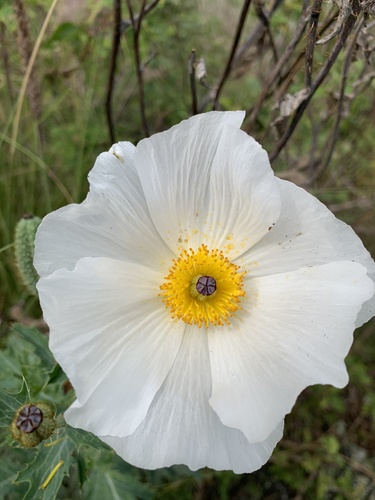


Pua Kala
argemone glauca
Pua Kala (Argemone glauca), also known as the Hawaiian poppy, is a striking endemic plant species native to the Hawaiian Islands. This hardy perennial is renowned for its brilliant white blossoms contrasted against a center of numerous bright yellow stamens. Thriving in the harsh, arid environments of coastal dunes, dry shrublands, and volcanic slopes, it stands out as one of the few native Hawaiian plants equipped with sharp defensive spines. Historically, Pua Kala held significant cultural and medicinal value for Native Hawaiians, who utilized its bright yellow, latex-like sap to relieve toothaches and skin ailments. Today, it serves as a vital component of Hawaii's fragile dryland ecosystems, providing nourishment for native pollinators and acting as a pioneer species on dry volcanic terrains.
生息地: Typically found on dry, rocky, and sun-exposed slopes, lava fields, and coastal shrublands across the Hawaiian Islands.
This erect, bushy herb typically reaches heights between 60 to 120 cm. It is easily identified by its spectacular, large white flowers with crepe-paper-like petals measuring up to 8 cm across, surrounding a dense central cluster of golden-yellow stamens. Its foliage is deeply lobed, pale bluish-green (glaucous), and heavily armed with sharp, stiff spines along the leaf margins and stems. After flowering, it produces oblong, spiny seed pods that split open to release numerous small black seeds.
カテゴリ
植物レア度
Common
危険度
1/5 · 非常に低い
スナップ
最初にスナップしよう!
Ancient Hawaiians used the bright yellow latex sap of the plant as an analgesic to treat painful toothaches and neuralgias.
Its scientific name, Argemone glauca, refers to its glaucescent or bluish-green waxy leaves that help it survive intense Hawaiian sunlight.
Pua Kala is one of the very few native Hawaiian plants that evolved physical defenses like thorns, which is unusual since Hawaii historically lacked native mammalian herbivores.
Produces a powdery, waxy coating on its leaves that gives them a bluish hue and helps reduce water loss in arid conditions.
Deters potential herbivores with sharp, formidable spines that densely cover its stems, leaves, and seed pods.
Develops a deep, robust taproot system to secure moisture and stabilize itself in loose volcanic soils.
As a photoautotrophic plant, Pua Kala generates its own food using sunlight, carbon dioxide, water, and minerals through the process of photosynthesis.
Hylaeus anthracinus
The endemic Hawaiian yellow-faced bee collects pollen from the large yellow centers of Pua Kala flowers.
Xylocopa sonorina
The introduced Sonoran carpenter bee visits the flowers for nectar and acts as an effective pollinator.
このオブジェクトにはまだ特徴バッジが割り当てられていません。
まだ別名はありません。
テーマが追加されると、このオブジェクトのコレクションがここに表示されます。
危険度
1/5 · 非常に低い
まだ特別な安全上の注意はありません。
Pua Kalaを識別する最も簡単な方法は、Snappit自然識別アプリを使用することです。
60-120 cm
2-5 年
As a photoautotrophic plant, Pua Kala generates its own food using sunlight, carbon dioxide, water, and minerals through the process of photosynthesis.
Typically found on dry, rocky, and sun-exposed slopes, lava fields, and coastal shrublands across the Hawaiian Islands.
50-150
14-28 日
ズームインしてクラスターを分割し、このオブジェクトが撮影された場所を探索しましょう。
新しい観察が追加されると、ここに最近のスナップが表示されます。