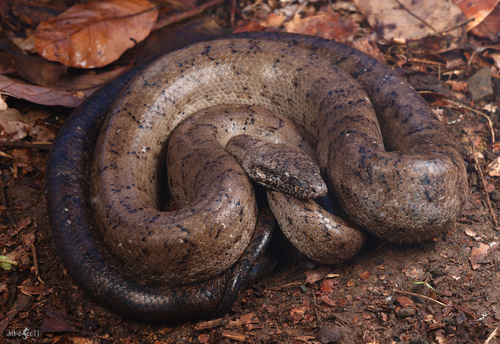


Puerto Rican Boa
chilabothrus inornatus
The Puerto Rican Boa is a magnificent, non-venomous constrictor endemic to the lush island of Puerto Rico. As the island's largest native land predator, this snake plays a crucial ecological role in controlling rodent and bat populations. Locally known as the 'boa de Puerto Rico', it has a calm disposition but is a highly efficient hunter, uniquely adapted to navigate both the dense forest canopies and the dark depths of subterranean caves. Observing one in its natural habitat is a thrilling experience, offering a glimpse into the delicate balance of Caribbean island ecosystems.
生息地: Primarily found in moist karst forests, cave systems, and dense tropical woodlands across Puerto Rico.
This medium-to-large-bodied snake typically displays a dark brown to blackish-brown ground color, often adorned with faint, dark, wavy cross-bands or spots along its back. Its scales possess a stunning iridescent sheen that shimmers with purple, blue, and green hues when caught in direct sunlight. It has a relatively slender body compared to other boas, with a distinct, elongated head that is visibly broader than its neck, and dark, analytical eyes.
カテゴリ
爬虫類レア度
Common
危険度
1/5 · 非常に低い
スナップ
最初にスナップしよう!
It is viviparous, meaning it gives birth to fully-formed live baby snakes rather than laying eggs.
The Puerto Rican Boa is famous for its coordinated group hunting behavior at cave entrances, where multiple snakes hang from the ceiling to capture bats.
When threatened, this snake can excrete a highly foul-smelling musk from its vent to deter potential predators.
This boa can hang suspended from cave ceilings or ledges to snatch flying bats out of mid-air as they emerge from their roosts.
It possesses specialized labial pits that detect infrared radiation, allowing it to locate warm-blooded prey in total darkness.
Its muscular, highly flexible tail acts like an extra limb, allowing the snake to securely anchor itself to branches and cave rocks.
An opportunistic carnivore that primarily targets small mammals, birds, and bats.
Mormoops blainvillei
The boa hunts this bat species at cave openings as they emerge at dusk.
Rattus rattus
Introduced rodents serve as a major food source for adult boas, especially in disturbed habitats.
Felis catus
Feral cats are known to prey upon juvenile boas, and sometimes adults.
このオブジェクトにはまだ特徴バッジが割り当てられていません。
テーマが追加されると、このオブジェクトのコレクションがここに表示されます。
危険度
1/5 · 非常に低い
まだ特別な安全上の注意はありません。
Puerto Rican Boaを識別する最も簡単な方法は、Snappit自然識別アプリを使用することです。
150+ cm
1+ kg
15+ 年
An opportunistic carnivore that primarily targets small mammals, birds, and bats.
Primarily found in moist karst forests, cave systems, and dense tropical woodlands across Puerto Rico.
Ambush Constriction
10+
ズームインしてクラスターを分割し、このオブジェクトが撮影された場所を探索しましょう。
新しい観察が追加されると、ここに最近のスナップが表示されます。









.JPG&width=800)