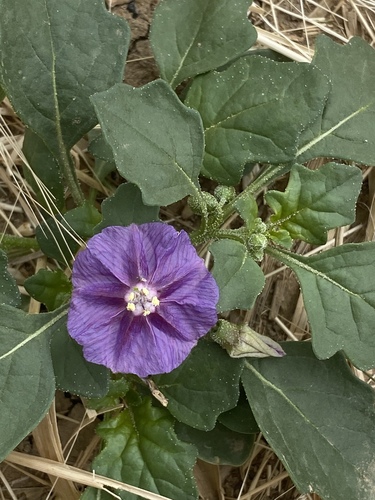


Purple Groundcherry
quincula lobata
The Purple Groundcherry (Quincula lobata) is a resilient, low-growing perennial herb native to the arid and semi-arid plains of North America. Belonging to the nightshade family (Solanaceae), this plant is celebrated for its striking, wheel-shaped violet-to-purple flowers that feature a distinctive white or yellow center. Unlike many of its groundcherry relatives that bear yellow blossoms, the purple groundcherry stands out with its rich hues, forming vibrant, low carpets of color across sandy and gravelly soils. Following pollination, the plant develops an intriguing fruit: a small, fleshy berry encased inside a papery, inflated lantern-like husk (the calyx). This unique structural adaptation not only protects the developing seeds from harsh desert conditions but also aids in seed dispersal by catching the wind. Drought-tolerant and hardy, the purple groundcherry is a vital component of its grassland ecosystem, providing nourishment to local pollinators and native wildlife.
生息地: Found in dry, open grasslands, desert scrub, plains, and disturbed sandy or gravelly soils across southwestern North America.
This plant forms low, sprawling mats up to 15 to 30 cm high, with trailing stems covered in small, wavy-margined (lobate) leaves of a dusty-green hue. The flowers are wheel-shaped, roughly 2 to 3 cm in diameter, exhibiting five fused petals in shades of deep purple, violet, or lavender, contrasted by a pale whitish-green star at the center. The fruit is a small, spherical green-to-yellow berry hidden completely inside a five-angled, bladder-like inflated calyx that dries to a papery tan casing.
カテゴリ
植物レア度
Common
危険度
1/5 · 非常に低い
スナップ
最初にスナップしよう!
The genus name 'Quincula' was historically established to separate this unique purple-flowered, low-growing species from other groundcherries.
The inflated papery husk surrounding the berry works like a tiny hot-air balloon, allowing the wind to roll the seed pod across the desert floor.
Unlike most other species of groundcherries which produce yellow or greenish flowers, Quincula lobata is famous for its bright purple to violet blossoms.
The calyx expands dramatically around the berry, forming a papery protective chamber that deters predators and aids in wind-assisted seed dispersal.
A deep, fleshy taproot allows the plant to store water and survive severe drought periods in arid environments.
The leaves are covered in tiny, scurfy hairs and crystalline glands that help reduce water loss and reflect intense desert sunlight.
As an autotroph, this plant generates its own energy through photosynthesis, utilizing sunlight, water, and carbon dioxide.
Halictus ligatus
Pollinated by native solitary bees looking for nectar and pollen.
Manduca quinquemaculata
The foliage is consumed by the hungry caterpillars of specialist moths.
Dipodomys ordii
The berries are eaten by small desert rodents, which then help disperse the seeds across the plains.
このオブジェクトにはまだ特徴バッジが割り当てられていません。
まだ別名はありません。
テーマが追加されると、このオブジェクトのコレクションがここに表示されます。
危険度
1/5 · 非常に低い
まだ特別な安全上の注意はありません。
Purple Groundcherryを識別する最も簡単な方法は、Snappit自然識別アプリを使用することです。
10-30 cm
2-10 年
As an autotroph, this plant generates its own energy through photosynthesis, utilizing sunlight, water, and carbon dioxide.
Found in dry, open grasslands, desert scrub, plains, and disturbed sandy or gravelly soils across southwestern North America.
ズームインしてクラスターを分割し、このオブジェクトが撮影された場所を探索しましょう。
新しい観察が追加されると、ここに最近のスナップが表示されます。










