

Purple Owl'S-Clover
castilleja exserta
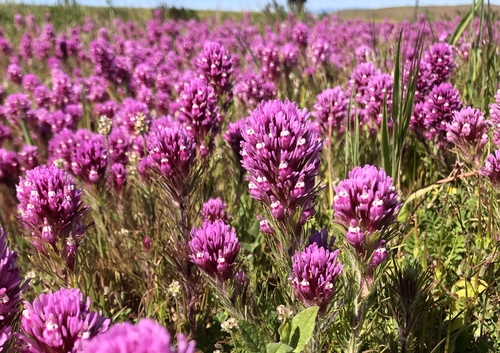
Meet the Purple Owl's-Clover, a vibrant annual wildflower that brings dazzling splashes of color to the open fields and grasslands of western North America. Despite its name, it is not a true clover; rather, it is a member of the broomrape family (Orobanchaceae) and a close relative of the Indian paintbrushes. This remarkable plant is famous not only for its stunning, brush-like pinkish-purple spikes but also for its fascinating, under-the-radar lifestyle as a hemiparasite. It quietly taps into the root systems of neighboring vegetation to steal water and essential nutrients, which allows it to thrive in arid conditions. Watching a field carpeted in these magenta spikes alongside yellow goldfields is one of the most iconic spring sights of the West Coast.
生息地: Found in open, sunny grasslands, chaparral, and coastal sage scrub communities across California and the Southwest.
Purple Owl's-Clover grows as an erect annual stem reaching 10 to 45 centimeters in height. It is highly recognizable by its dense, paintbrush-like flower spikes crowded with bright pink, purple, or magenta bracts. Tucked within these colorful bracts are the actual flowers, which feature a distinct, white or yellow-tipped lower lip with two dark purple dots, giving them an uncanny resemblance to the face and eyes of a tiny owl.
カテゴリ
植物レア度
Common
危険度
1/5 · 非常に低い
スナップ
最初にスナップしよう!
By stealing toxic chemicals from host plants like lupines, it essentially crafts its own chemical shield against hungry rabbits and deer.
Despite its name, it is not a true clover but actually belongs to the broomrape family, Orobanchaceae.
The common name 'Owl's-clover' comes from the shape of the petals nested inside the colorful bracts, which mimic a tiny owl's head.
Uses specialized root structures called haustoria to invade and attach to the root systems of neighboring plants, extracting water and essential minerals.
Sequesters toxic alkaloids from its host plants, which makes its own tissues toxic and highly unpalatable to grazing herbivores.
Completes its entire lifecycle rapidly in early spring, producing seeds that can lie dormant through the hot, dry summer months.
As a photosynthetic hemiparasite, it manufactures sugars through photosynthesis but absorbs water and inorganic nutrients directly from host plant roots.
Euphydryas editha
Serves as a host plant for larvae, which consume the plant and sequester its toxic defense compounds.
Bombus vosnesenskii
Rely on these large bees for pollination as they squeeze into the complex flower structures.
Lupinus nanus
Commonly parasitized by Purple Owl's-Clover, which taps its roots to steal water and defensive alkaloids.
このオブジェクトにはまだ特徴バッジが割り当てられていません。
まだ別名はありません。
テーマが追加されると、このオブジェクトのコレクションがここに表示されます。
危険度
1/5 · 非常に低い
まだ特別な安全上の注意はありません。
Purple Owl'S-Cloverを識別する最も簡単な方法は、Snappit自然識別アプリを使用することです。
10+ cm
1+ 年
As a photosynthetic hemiparasite, it manufactures sugars through photosynthesis but absorbs water and inorganic nutrients directly from host plant roots.
Found in open, sunny grasslands, chaparral, and coastal sage scrub communities across California and the Southwest.
ズームインしてクラスターを分割し、このオブジェクトが撮影された場所を探索しましょう。
新しい観察が追加されると、ここに最近のスナップが表示されます。

California, US
ここで見られるかも カリフォルニアポピー, ワキモンユタトカゲ と ファセリア.
ガイドを見る →

California, US
ここで見られるかも Warrior's Plume, Purple Owl's-Clover と Woolly Paintbrush.
ガイドを見る →

California, US
ここで見られるかも ハイイロタテハモドキ, カリフォルニアトチノキ と San Joaquin Milkvetch.
ガイドを見る →

California, US
ここで見られるかも ニシカキネトカゲ, Springtime Amanita と California Golden Violet.
ガイドを見る →










