

Purple Pricklypear
opuntia azurea
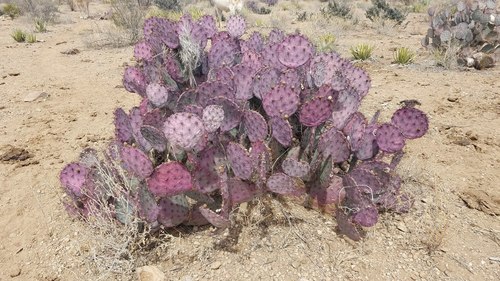
The Purple Pricklypear (Opuntia azurea) is a strikingly beautiful cactus native to the Chihuahuan Desert, prized for its vivid, jewel-toned pads that shift from a frosty blue-green to a deep, dramatic purple. This vibrant coloration is actually a stress response to cold temperatures, intense drought, or harsh sunlight, producing anthocyanins that act as a natural sunscreen and antifreeze. Beyond its stunning foliage, this resilient succulent produces brilliant yellow flowers with striking crimson centers, creating a breathtaking visual contrast against its colorful, spine-covered pads in the spring. It is a quintessential desert survivor, expertly adapted to thrive in harsh, rocky landscapes where water is incredibly scarce.
生息地: Found in arid deserts, rocky slopes, and dry limestone outcrops throughout the Chihuahuan Desert region.
This low-growing, spreading cactus features flat, obovate-to-circular pads (cladodes) measuring about 10 to 15 centimeters in diameter. While typically blue-green, the pads turn a vibrant reddish-purple around the edges or entirely during winter or drought conditions. The pads are heavily armed with long, needle-like spines that are dark brown to almost black at the base, fading to yellow or gray at the tips, surrounded by clusters of tiny, irritating bristles called glochids. During the blooming season, it produces showy, cup-shaped yellow flowers with dark magenta throats, which later give way to small, fleshy, dark red to purplish fruits.
カテゴリ
植物レア度
Common
危険度
1/5 · 非常に低い
スナップ
最初にスナップしよう!
Its scientific name 'azurea' translates to 'sky blue', referencing the frosty blue-green hue the pads display when they aren't stressed into turning purple.
Like many prickly pears, the vibrant yellow flowers only bloom for a single day, opening mid-morning and closing tightly by dusk.
The cactus is often parasitized by the cochineal bug, which produces a brilliantly deep red dye when crushed, historically used by indigenous peoples for textiles.
The vibrant purple color of the pads actually intensifies during cold snaps or periods of extreme drought, acting as a natural defense mechanism against harsh weather.
This cactus utilizes CAM photosynthesis, keeping its stomata closed during the hot day to conserve water and opening them at night to absorb carbon dioxide.
The plant produces high levels of purple anthocyanin pigments in response to environmental stress, protecting its cellular structures from intense UV radiation and cold damage.
In addition to prominent spines, the pads possess hundreds of tiny, barbed bristles called glochids that easily detach to deter thirsty herbivores.
As a photoautotroph, the Purple Pricklypear creates its own food using sunlight, water, and carbon dioxide from its arid environment.
Diadasia rinconis
Native bees are the primary pollinators of its vibrant flowers.
Pecari tajacu
Desert mammals rely on its fleshy, water-rich fruits for hydration and food.
Dactylopius coccus
Insects feed on the pads, often leaving protective white webbing.
このオブジェクトにはまだ特徴バッジが割り当てられていません。
まだ別名はありません。
テーマが追加されると、このオブジェクトのコレクションがここに表示されます。
危険度
1/5 · 非常に低い
まだ特別な安全上の注意はありません。
Purple Pricklypearを識別する最も簡単な方法は、Snappit自然識別アプリを使用することです。
30-90 cm
1-10 kg
10-25 年
As a photoautotroph, the Purple Pricklypear creates its own food using sunlight, water, and carbon dioxide from its arid environment.
Found in arid deserts, rocky slopes, and dry limestone outcrops throughout the Chihuahuan Desert region.
Photosynthesis
ズームインしてクラスターを分割し、このオブジェクトが撮影された場所を探索しましょう。
新しい観察が追加されると、ここに最近のスナップが表示されます。





.jpg&width=800)












