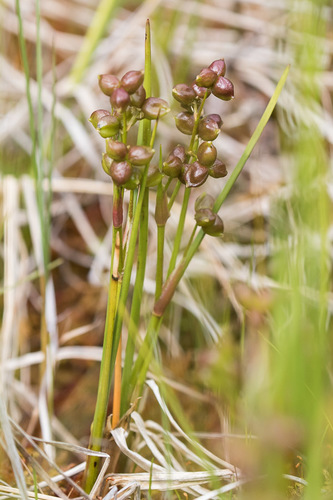


Rannoch-Rush
scheuchzeria palustris
The Rannoch-Rush, *Scheuchzeria palustris*, is a fascinating and rare perennial herb belonging to the monotypic genus *Scheuchzeria*. Often considered a relict species, it provides a glimpse into ancient plant lineages. This distinctive plant thrives in some of the most challenging environments: nutrient-poor, acidic peatlands and sphagnum bogs across northern temperate regions. Its presence is often an indicator of pristine, undisturbed wetland ecosystems, making it a valuable species for ecological monitoring. Despite its delicate appearance, it is incredibly resilient, relying on specialized adaptations to colonize and persist in waterlogged, acidic conditions where many other plants cannot survive. Its unique reproductive strategies and specific habitat requirements underscore its importance in biodiversity.
生息地: Found in highly acidic, nutrient-poor sphagnum bogs, fens, and quaking mats, often in shallow pools or on wet, peaty shores.
The Rannoch-Rush is a slender, grass-like plant typically growing 10-30 centimeters tall. Its leaves are narrow, linear, and grooved, resembling rushes or sedges, often having a reddish tinge towards the base. The inconspicuous flowers are small, greenish-yellow, and arranged in a loose, terminal raceme. Each flower develops into a distinctive, inflated, bladder-like fruit composed of three carpels, which are green and turn brownish as they mature. These fruits are a key visual identifier, giving the plant a unique appearance among its bog companions.
カテゴリ
植物レア度
Common
危険度
1/5 · 非常に低い
スナップ
最初にスナップしよう!
It is often found growing on 'quaking mats' in bogs, areas where the ground literally shakes or bounces underfoot due to water saturation and a thick layer of floating vegetation.
Its scientific name honors Johann Jacob Scheuchzer, an 18th-century Swiss naturalist who pioneered the study of alpine flora.
The Rannoch-Rush is the sole species in the genus *Scheuchzeria*, making it a unique botanical survivor from ancient lineages.
The seeds of *Scheuchzeria palustris* are buoyant and can float on water, a crucial adaptation for dispersal within its waterlogged bog habitats.
The Rannoch-Rush has evolved to thrive in highly acidic (low pH) peatland environments, conditions that are toxic or inhibit growth for most other plant species. This adaptation allows it to dominate its specialized niche.
Its seeds are lightweight and buoyant, encased within inflated, bladder-like fruits. This allows them to float on water, effectively dispersing to new suitable boggy locations within its wetland habitat.
The plant utilizes creeping underground rhizomes for vegetative reproduction. This method enables it to form clonal colonies, spreading efficiently and colonizing new areas within its preferred habitat.
As an autotrophic plant, the Rannoch-Rush produces its own food through photosynthesis. It converts sunlight energy, carbon dioxide, and water into sugars, utilizing dissolved nutrients from the acidic bog water to support its growth.
Sphagnum spp.
Forms the primary substrate and creates the highly acidic, waterlogged conditions required by Rannoch-Rush.
Various Diptera species
Small insects may act as generalist pollinators for its inconspicuous flowers.
Eriophorum spp.
Provides habitat and shelter within the bog ecosystem.
Andromeda polifolia
Their presence often indicates shared preferences for acidic bog environments.
このオブジェクトにはまだ特徴バッジが割り当てられていません。
まだ別名はありません。
テーマが追加されると、このオブジェクトのコレクションがここに表示されます。
危険度
1/5 · 非常に低い
まだ特別な安全上の注意はありません。
Rannoch-Rushを識別する最も簡単な方法は、Snappit自然識別アプリを使用することです。
10-30 cm
0.01-0.05 kg
5-20 年
As an autotrophic plant, the Rannoch-Rush produces its own food through photosynthesis. It converts sunlight energy, carbon dioxide, and water into sugars, utilizing dissolved nutrients from the acidic bog water to support its growth.
Found in highly acidic, nutrient-poor sphagnum bogs, fens, and quaking mats, often in shallow pools or on wet, peaty shores.
Photosynthesis
20-100
ズームインしてクラスターを分割し、このオブジェクトが撮影された場所を探索しましょう。
新しい観察が追加されると、ここに最近のスナップが表示されます。









_(8616886668).jpg&width=800)




