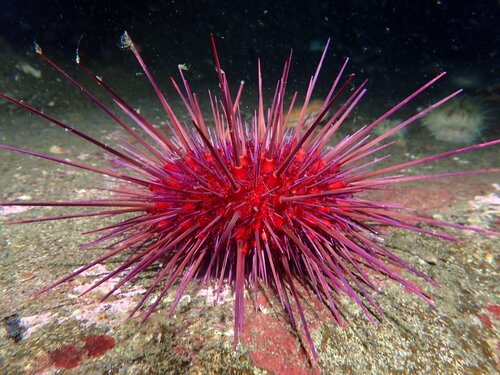


Red Sea Urchin
mesocentrotus franciscanus
The red sea urchin (Mesocentrotus franciscanus) is an iconic and visually striking invertebrate native to the shallow coastal waters of the northeastern Pacific Ocean. Covered in formidable, needle-like spines, these fascinating marine creatures look like living, slow-moving pincushions scattered across the ocean floor. They play a critical and complex role in kelp forest ecosystems, grazing heavily on algae and acting as a primary food source for keystone predators like sea otters and sunflower stars. What truly sets the red sea urchin apart is its astonishing longevity; scientists have discovered that some individuals can live for well over 100 years, with a few ancient giants surviving past the two-century mark without showing signs of biological aging. Commercially prized for their rich, buttery roe—known as 'uni' in sushi cuisine—they are both ecologically and economically significant. Observing these brilliantly colored, spiky globes nestled among rocky reefs offers a captivating glimpse into the vibrant biodiversity of Pacific kelp forests.
生息地: Found primarily among rocky reefs and thriving kelp forests in the shallow, turbulent coastal waters of the northeastern Pacific Ocean.
Red sea urchins are characterized by their spherical, calcareous shells (called tests) that can grow up to 19 centimeters in diameter, making them the largest of all sea urchin species. They are densely covered in long, sharp, rigid spines that can reach up to 8 centimeters in length, providing a formidable physical defense mechanism against predators. Despite their common name, their coloration varies significantly, ranging from bright, vibrant crimson and deep burgundy to darker shades of purple or even blackish-red. On their underside, nestled among hundreds of tiny, transparent tube feet, they possess a complex mouth structure known as Aristotle's lantern, which is equipped with five distinct, self-sharpening teeth used for grazing.
カテゴリ
Animalレア度
Common
危険度
1/5 · 非常に低い
スナップ
最初にスナップしよう!
Red sea urchins are among the longest-living animals on Earth, with some individuals estimated to be over 200 years old, showing virtually no signs of biological aging.
Their reproductive organs, known as roe or 'uni', are considered a worldwide culinary delicacy in sushi cuisine, driving a highly lucrative commercial fishery.
They do not possess a central brain; instead, their nervous system consists of a decentralized nerve ring that encircles their mouth and branches out to their tube feet and spines.
When an urchin senses the chemical signature of a damaged sea star or another predator in the water, it will rapidly wave its spines and attempt to flee the area.
Features a highly complex, five-jawed chewing organ equipped with self-sharpening calcium carbonate teeth. This allows them to effectively scrape tough kelp and crustose coralline algae off solid rock.
Utilizes hundreds of tiny, water-vascular tube feet equipped with suction cups. These allow the urchin to grasp rocks tightly against strong wave action and slowly navigate the ocean floor.
Can continuously regenerate their protective spines, shell material, and tube feet if they are broken or damaged by predators or powerful ocean currents.
Red sea urchins are primarily benthic grazers that feed extensively on fleshy macroalgae, acting as a major consumer in kelp forest ecosystems.
年齢による違い: Planktonic larvae feed on microscopic phytoplankton, while adults switch to grazing heavily on large, leafy macroalgae like kelp.
Enhydra lutris
Acts as a primary predator controlling urchin populations.
Macrocystis pyrifera
Serves as the primary food source and habitat provider for the urchin.
Pycnopodia helianthoides
A large predatory sea star that naturally hunts and consumes sea urchins.
このオブジェクトにはまだ特徴バッジが割り当てられていません。
まだ別名はありません。
テーマが追加されると、このオブジェクトのコレクションがここに表示されます。
危険度
1/5 · 非常に低い
まだ特別な安全上の注意はありません。
Red Sea Urchinを識別する最も簡単な方法は、Snappit自然識別アプリを使用することです。
5-19 cm
0.1-0.8 kg
30-200 年
Red sea urchins are primarily benthic grazers that feed extensively on fleshy macroalgae, acting as a major consumer in kelp forest ecosystems.
Found primarily among rocky reefs and thriving kelp forests in the shallow, turbulent coastal waters of the northeastern Pacific Ocean.
Grazing
10000-99999
ズームインしてクラスターを分割し、このオブジェクトが撮影された場所を探索しましょう。
新しい観察が追加されると、ここに最近のスナップが表示されます。




