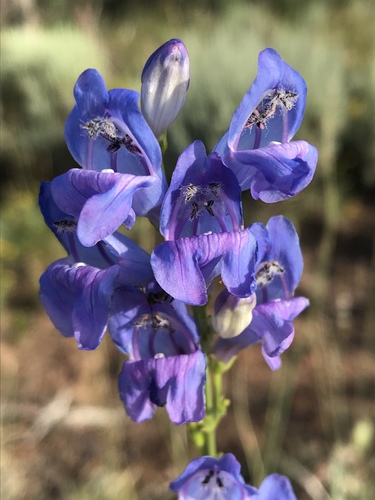


Rocky Mountain Beardtongue
penstemon strictus
The Rocky Mountain Beardtongue (Penstemon strictus) is a vibrant, clump-forming perennial wildflower native to the western United States, particularly the mountain and plateau regions. Belonging to the plantain family, this hardy species is celebrated for its stunning spikes of deep blue to violet-purple, tubular flowers that bloom from late spring through mid-summer. It plays a vital role in its native ecosystems, acting as a magnet for a wide variety of native pollinators, including bumblebees, solitary bees, and hummingbirds. Adaptable and resilient, this species thrives in dry, rocky soils and is highly drought-tolerant once established. Because of its striking beauty, low maintenance requirements, and ability to thrive in challenging conditions, the Rocky Mountain Beardtongue has also become a highly popular choice for native plant gardens, xeriscaping, and soil erosion control projects in arid regions.
生息地: Found in open pine and juniper woodlands, sagebrush scrub, and montane meadows at elevations ranging from 1,500 to 3,000 meters.
This plant features erect, unbranched stems growing from 30 to 80 centimeters tall, rising above a basal mat of smooth, lance-shaped, evergreen to semi-evergreen leaves. The most striking feature is the one-sided flower spike (thyrse), where numerous tubular, two-lipped flowers cluster. These blossoms range in color from a brilliant violet-blue to rich purple, with a throat that is often streaked with delicate magenta lines. Inside the flower, the sterile stamen (the 'beardtongue') is typically hairless or has very sparse yellow hairs, distinguishing it from other similar-looking Penstemon species.
カテゴリ
植物レア度
Common
危険度
1/5 · 非常に低い
スナップ
最初にスナップしよう!
Despite its common name beardtongue, Penstemon strictus actually has a mostly hairless sterile stamen, making it smoother than many of its relatives.
The genus name Penstemon comes from Greek words meaning five stamens, referring to the characteristic fifth sterile stamen inside each flower.
This plant is highly valued for erosion control because its fibrous root system binds loose, rocky mountain soils together.
Features a deep, robust root system and thick, leathery leaves that allow it to conserve water and survive in arid, rocky soils.
The tubular shape and vivid blue-purple coloration of its flowers are specifically evolved to attract long-tongued bees and hummingbirds.
Maintains a low-growing basal rosette of leaves throughout the winter, allowing it to photosynthesize immediately when spring arrives.
As a photoautotrophic plant, it synthesizes its own food using sunlight, water, and carbon dioxide through the process of photosynthesis.
Bombus huntii
Serves as a primary pollinator, seeking nectar inside the tubular flowers.
Selasphorus platycercus
Visits the vibrant purple flowers for nectar, facilitating cross-pollination.
Euphydryas anicia
Larvae feed on the foliage of the plant, which serves as an important host.
このオブジェクトにはまだ特徴バッジが割り当てられていません。
まだ別名はありません。
テーマが追加されると、このオブジェクトのコレクションがここに表示されます。
危険度
1/5 · 非常に低い
まだ特別な安全上の注意はありません。
Rocky Mountain Beardtongueを識別する最も簡単な方法は、Snappit自然識別アプリを使用することです。
30-80 cm
3-8 年
As a photoautotrophic plant, it synthesizes its own food using sunlight, water, and carbon dioxide through the process of photosynthesis.
Found in open pine and juniper woodlands, sagebrush scrub, and montane meadows at elevations ranging from 1,500 to 3,000 meters.
ズームインしてクラスターを分割し、このオブジェクトが撮影された場所を探索しましょう。
新しい観察が追加されると、ここに最近のスナップが表示されます。

New Mexico, US
ここで見られるかも Rocky Mountain Beardtongue, バルカンキンギョソウ と ルイスキツツキ.
ガイドを見る →

Colorado, US
ここで見られるかも ヤナギラン, カミツレモドキ と アメリカヤマナラシ.
ガイドを見る →

Colorado, US
ここで見られるかも アメリカサンゴミズキ, ホソバヒイラギナンテン と キバナシナガワハギ.
ガイドを見る →



.jpg&width=800)








