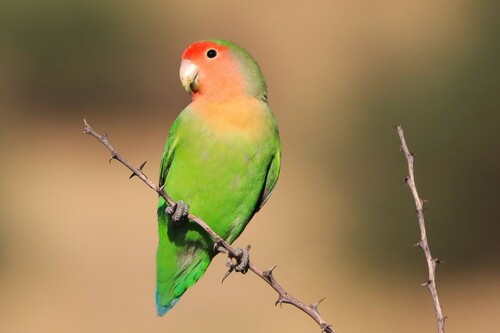


Rosy-Faced Lovebird
agapornis roseicollis
The Rosy-Faced Lovebird is a small, highly social parrot native to the arid regions of southwestern Africa. Famous for its vibrant coloration and affectionate pair-bonding behavior, this energetic bird is beloved by both wild birdwatchers and aviculturists worldwide. They are highly gregarious, often gathering in noisy flocks near water sources in their native dry woodland and semi-desert habitats. In their native range, they are known for their resourcefulness, nesting in rock crevices, communal nests built by other birds, or even human structures. Despite their small size, they possess a bold personality and a loud, metallic shriek. They have also established successful feral populations in urban areas outside of Africa, notably in Phoenix, Arizona, where they have adapted incredibly well to desert-scaped suburbs.
生息地: Found in dry, open country, semi-deserts, and wooded savannas, typically staying close to reliable water sources.
This compact, short-tailed parrot is easily identified by its bright green body plumage, which contrasts beautifully with a peach-pink face and throat, giving them their common name. They feature a prominent blue rump, a horn-colored bill, and grey feet. Measuring around 15 cm in length, they have a stocky build with a relatively large head, and their wingspan ranges between 20 to 24 cm.
カテゴリ
鳥類レア度
Common
危険度
1/5 · 非常に低い
スナップ
最初にスナップしよう!
An introduced population has thrived in the hot desert of Phoenix, Arizona, since the 1980s, nesting in saguaro cacti and backyard birdhouses.
Females carry nesting materials by tucking strips of leaves, bark, or paper into their rump feathers, looking like they have a colorful tail extension.
They get their name 'lovebird' from the intense, lifelong monogamous bonds they form with their mates, often spending hours preening each other.
Females strip bark or leaves and tuck them into their rump feathers to carry them back to the nest site.
They are highly adapted to dry environments, obtaining much of their moisture from seeds and visiting waterholes daily.
They communicate using rapid, high-pitched contact calls that keep the flock tightly coordinated during flight.
Feeds primarily on seeds, grains, and buds, often foraging on the ground or in low bushes.
Philetairus socius
Frequently uses the nesting chambers of the massive colonial structures built by this bird in the wild.
Falco biarmicus
Preys on adult and juvenile lovebirds in their native African range.
このオブジェクトにはまだ特徴バッジが割り当てられていません。
まだ別名はありません。
テーマが追加されると、このオブジェクトのコレクションがここに表示されます。
危険度
1/5 · 非常に低い
まだ特別な安全上の注意はありません。
Rosy-Faced Lovebirdを識別する最も簡単な方法は、Snappit自然識別アプリを使用することです。
15+ cm
20+ cm
0.046+ kg
10+ 年
40 km/h
Feeds primarily on seeds, grains, and buds, often foraging on the ground or in low bushes.
Found in dry, open country, semi-deserts, and wooded savannas, typically staying close to reliable water sources.
ズームインしてクラスターを分割し、このオブジェクトが撮影された場所を探索しましょう。
新しい観察が追加されると、ここに最近のスナップが表示されます。














