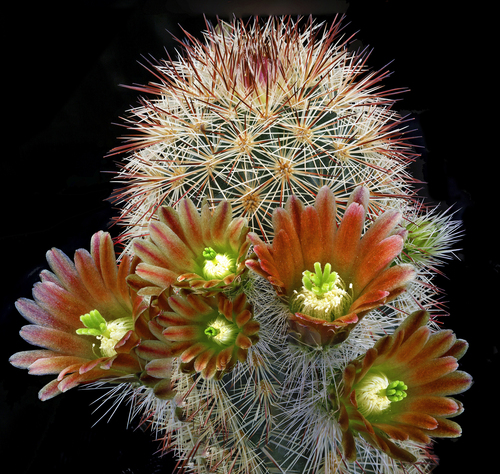


Russet Hedgehog Cactus
echinocereus russanthus
The Russet Hedgehog Cactus (Echinocereus russanthus) is a captivating, low-growing desert succulent native to the arid borderlands of West Texas and northern Mexico. Known for its cylindrical stems densely covered in reddish-brown, russet-colored spines, this resilient cactus is a master of desert survival. During the spring, it displays beautiful, small, tubular flowers that range in color from brownish-red to rust-orange, providing a stunning contrast to its rugged, spiny exterior. These cacti often grow in small clusters or as solitary stems tucked among limestone rocks and gravelly slopes. Their incredible ability to withstand extreme temperatures, from scorching summer heat to freezing winter nights, makes them a fascinating subject for desert botanists and plant enthusiasts alike.
生息地: Found on dry, rocky limestone hillsides, gravelly flats, and desert grasslands, often nestled among cracks in rock outcrops.
This cactus features cylindrical, ribbed stems that typically grow up to 10 to 30 centimeters tall and 5 to 8 centimeters in diameter, occurring singly or in small clumps. The plant is heavily armored with dense, interlocking spines that showcase a distinctive russet, reddish-brown, or copper-yellow coloration. Flowers emerge from the sides of the stems in spring, measuring about 2 to 3 centimeters in length and width, with petals that exhibit warm shades of rust, dark red, or greenish-bronze. The small, spiny, greenish-red fruits that follow are oval-shaped and contain tiny black seeds.
カテゴリ
植物レア度
Common
危険度
1/5 · 非常に低い
スナップ
最初にスナップしよう!
Its dense network of reddish spines acts like natural sunscreen, casting micro-shadows that cool the plant's skin.
The common name hedgehog cactus comes from the Greek word echinos, meaning sea urchin or hedgehog, describing its spiny exterior.
Unlike many desert cacti with brilliant yellow or pink flowers, this species produces unique rust-colored or greenish-brown blossoms.
To conserve water, the cactus opens its stomata at night to absorb carbon dioxide, storing it for daytime photosynthesis when its pores remain tightly shut.
Its dense, overlapping reddish spines protect the stem from intense solar radiation and reduce water loss from dry desert winds.
The accordion-like ribs of the stem expand to store large volumes of water after brief desert rains and contract during droughts.
As a photoautotrophic plant, it manufactures its own food using sunlight, carbon dioxide, and water through the process of photosynthesis.
Diadasia opuntiae
Feeds on nectar and pollen from the flowers while acting as a primary pollinator.
Peromyscus eremicus
Consumes the sweet, fleshy red fruits and aids in dispersing the seeds across the desert floor.
このオブジェクトにはまだ特徴バッジが割り当てられていません。
まだ別名はありません。
テーマが追加されると、このオブジェクトのコレクションがここに表示されます。
危険度
1/5 · 非常に低い
まだ特別な安全上の注意はありません。
Russet Hedgehog Cactusを識別する最も簡単な方法は、Snappit自然識別アプリを使用することです。
10-30 cm
0.2-1.5 kg
10-30 年
As a photoautotrophic plant, it manufactures its own food using sunlight, carbon dioxide, and water through the process of photosynthesis.
Found on dry, rocky limestone hillsides, gravelly flats, and desert grasslands, often nestled among cracks in rock outcrops.
ズームインしてクラスターを分割し、このオブジェクトが撮影された場所を探索しましょう。
新しい観察が追加されると、ここに最近のスナップが表示されます。