

Salvinia Stem Borer Moth
samea multiplicalis
The Salvinia stem borer moth (Samea multiplicalis) is a fascinating little moth that plays a huge role in aquatic ecosystems. Native to the warmer regions of the Americas, this species is famous for its relationship with floating freshwater weeds, particularly the invasive Salvinia water ferns. While the adults are small and cryptically patterned, it is the caterpillar stage that does the heavy lifting, boring into the spongy leaves and stems of host plants and effectively destroying them. Because of their voracious appetite for these fast-growing aquatic weeds, they have been widely studied and introduced in various parts of the world as highly successful biological control agents. Observing them in the wild offers a unique look at how a tiny insect can act as a natural regulator of entire wetland habitats.
生息地: Typically found in freshwater wetlands, slow-moving rivers, lakes, and marshes where dense mats of floating aquatic plants like water lettuce or salvinia accumulate.
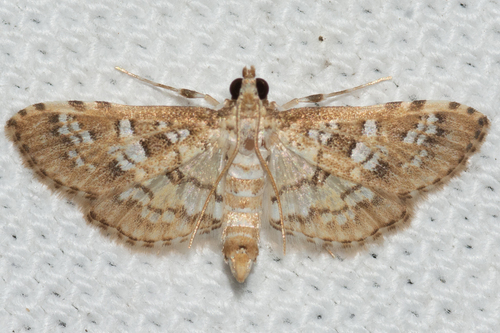
Adults of the Salvinia stem borer moth are delicate, small insects with a wingspan ranging from 1.5 to 2.2 cm. Their forewings feature an intricate mosaic pattern of rich brown, tan, and cream-colored markings, interspersed with distinctive semi-translucent, white triangular patches. The hindwings share a similar but lighter mottled design. When at rest, they hold their wings flat in a triangular shape, blending seamlessly into dried aquatic vegetation. The caterpillars are translucent yellow-green with a dark brown head capsule, transitioning to a pinkish-orange hue as they mature.
カテゴリ
昆虫レア度
Common
危険度
1/5 · 非常に低い
スナップ
最初にスナップしよう!
Because they target invasive weeds that choke waterways and block sunlight, these moths indirectly help restore oxygen levels and native biodiversity in lakes.
Despite being tiny, a dense population of these caterpillars can completely sink entire floating mats of giant salvinia by destroying their buoyancy chambers.
Their pupae are uniquely adapted to survive inside water-resistant silk cocoons spun directly inside the water-soaked stems of their host plants.
The larvae possess specialized mandibles allowing them to tunnel directly into the floating stems and petioles of aquatic plants, shielding them from predators while they feed.
Larvae and pupae have water-repellent body surfaces that protect them from drowning within their humid, semi-submerged feeding tunnels.
The species can complete its entire life cycle in less than a month, allowing populations to rapidly explode and collapse vast mats of invasive weeds.
As larvae, they feed exclusively on the leaves, petioles, and stems of floating aquatic plants, while adults generally do not feed or only consume nectar.
Salvinia molesta
Larvae feed heavily on this invasive floating fern, acting as a biological control agent.
Pistia stratiotes
Larvae feed on the leaves of this floating plant, often nesting within the rosette.
Notonecta glauca
Larvae and pupae of the moth are preyed upon by aquatic bugs such as backswimmers.
このオブジェクトにはまだ特徴バッジが割り当てられていません。
まだ別名はありません。
テーマが追加されると、このオブジェクトのコレクションがここに表示されます。
危険度
1/5 · 非常に低い
まだ特別な安全上の注意はありません。
Salvinia Stem Borer Mothを識別する最も簡単な方法は、Snappit自然識別アプリを使用することです。
1+ cm
1+ cm
As larvae, they feed exclusively on the leaves, petioles, and stems of floating aquatic plants, while adults generally do not feed or only consume nectar.
Typically found in freshwater wetlands, slow-moving rivers, lakes, and marshes where dense mats of floating aquatic plants like water lettuce or salvinia accumulate.
Grazing
50+
4+ 日
ズームインしてクラスターを分割し、このオブジェクトが撮影された場所を探索しましょう。
新しい観察が追加されると、ここに最近のスナップが表示されます。

















