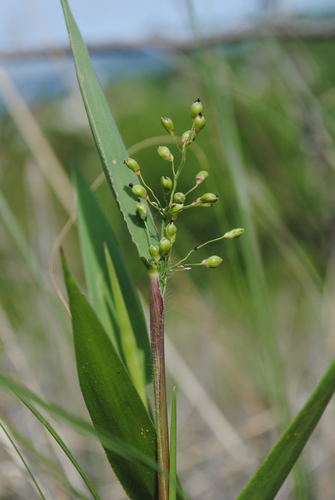


Scribner'S Panicgrass
dichanthelium scribnerianum
Scribner's panicgrass is a hardy, native perennial bunchgrass widespread across North American prairies, savannahs, and open woodlands. Known for its fascinating dimorphic growth cycle, it transitions from a low-growing winter rosette of broad, flat leaves to taller, branching stems topped with delicate seed panicles in the summer. It plays a quiet but vital role in local ecosystems by stabilizing sandy or rocky soils and offering high-quality forage and nesting cover for various insects, birds, and small mammals. This resilient grass is well-adapted to survive wild prairie fires and seasonal dry spells, bouncing back with vigor each spring. Its ability to produce seeds through two different flowering mechanisms makes it highly successful in securing its place in diverse grasslands.
生息地: Found in dry prairies, sandy savannahs, open woodlands, and disturbed fields, often in rocky or sandy soils.
Scribner's panicgrass forms tufted clumps reaching 15 to 60 centimeters tall. It features distinctive, relatively wide, lance-shaped leaves measuring up to 15 millimeters across, which are arranged alternately along upright, hairy culms. In late spring and summer, the plant produces an egg-shaped or pyramidal panicle, 4 to 8 centimeters long, consisting of small, rounded, light green spikelets that turn golden-brown as they mature. In the cooler months, the plant retreats to a low, rosette form with shorter, broader leaves that remain surprisingly green throughout the winter.
カテゴリ
植物レア度
Common
危険度
1/5 · 非常に低い
スナップ
最初にスナップしよう!
It produces cleistogamous flowers in the fall, which are self-pollinated and fertilize themselves without ever opening.
The genus name Dichanthelium translates from Greek to mean 'twice-blooming,' referring to its unique spring and autumn flowering phases.
Unlike many prairie grasses, its basal rosettes stay green throughout the winter, providing a crucial food source for small herbivores when snow is on the ground.
Changes form between a low-growing winter basal rosette and upright, branching summer stems to maximize survival in varying temperatures.
Produces open, cross-pollinated flowers in the spring and self-pollinating, closed flowers in the autumn to guarantee seed production.
Re-sprouts quickly from underground rhizomes after prairie fires, capitalizing on cleared ground and nutrient-rich ash.
This plant produces its own food by converting sunlight, carbon dioxide, water, and soil minerals into chemical energy through photosynthesis.
Polites peckius
The larvae of this butterfly feed on the foliage of Scribner's panicgrass.
Meleagris gallopavo
Turkeys consume the small, nutritious seeds produced in the summer panicles.
Microtus pennsylvanicus
Voles forage on the green winter rosettes of the grass when other food sources are scarce.
このオブジェクトにはまだ特徴バッジが割り当てられていません。
まだ別名はありません。
テーマが追加されると、このオブジェクトのコレクションがここに表示されます。
危険度
1/5 · 非常に低い
まだ特別な安全上の注意はありません。
Scribner'S Panicgrassを識別する最も簡単な方法は、Snappit自然識別アプリを使用することです。
15-60 cm
3-8 年
This plant produces its own food by converting sunlight, carbon dioxide, water, and soil minerals into chemical energy through photosynthesis.
Found in dry prairies, sandy savannahs, open woodlands, and disturbed fields, often in rocky or sandy soils.
ズームインしてクラスターを分割し、このオブジェクトが撮影された場所を探索しましょう。
新しい観察が追加されると、ここに最近のスナップが表示されます。



















