

Sea Rose
armeria pungens
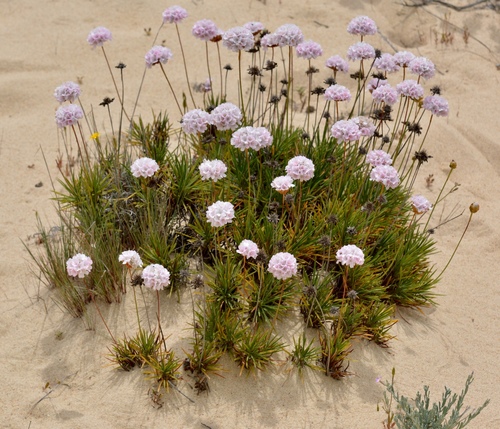
The Sea Rose (Armeria pungens), also known as the Spiny Thrift, is an enduring and resilient perennial subshrub native to the coastal sand dunes of the western Mediterranean. Thriving in harsh, wind-swept, and saline environments where few other plants can survive, it stands as a testament to evolutionary endurance. With its woody, cushion-like base and upright stems topped by vibrant globose flower heads, the Sea Rose plays a critical role in stabilizing fragile dune ecosystems, preventing erosion with its deep, robust root system. This botanical gem blooms spectacularly from late spring through summer, painting coastal sands with shades of pink and white. It has adapted remarkably to survive intense sun, high winds, and salt spray, making it a key ecological component of Mediterranean coastal environments. Its ability to thrive in poor soils makes it a fascinating subject for study in plant adaptation and a charming sight for coastal hikers.
生息地: Found primarily in coastal sand dunes, sandy maritime cliffs, and scrublands along the Mediterranean and Atlantic shorelines.
Armeria pungens is characterized by its compact, woody, and intensely branched base, which forms dense, rounded cushions up to 80 cm in height. It features narrow, rigid, and needle-like leaves that are sharp-pointed, helping to conserve water in arid conditions. The most striking feature is its inflorescence: dense, spherical flower heads measuring 2 to 3 cm in diameter, consisting of numerous small pink to white tubular flowers. These flower heads are perched atop long, leafless, and erect stalks that rise elegantly above the spiky green cushion below.
カテゴリ
植物レア度
Common
危険度
1/5 · 非常に低い
スナップ
最初にスナップしよう!
Because of its highly adapted root system, it acts as an ecological sand-binder, helping to build and preserve the coastal dunes that protect inland areas from storms.
Despite living in high-salt environments, it does not actually accumulate salt in its tissues, instead relying on specialized physiological barriers to block sodium uptake.
The species name 'pungens' is Latin for 'prickly' or 'sharp-pointed,' referring to its stiff, needle-like leaves that can give a sharp prick to unsuspecting touchers.
The spherical pink flower heads resemble miniature pom-poms swaying above the coastal sands, earning the genus name Armeria which is linked to Celtic words for the seaside.
It possesses specialized cellular adaptations to tolerate high salt levels from sea spray, preventing tissue damage in maritime environments.
Its leaves are tough, narrow, and sharply pointed, reducing the surface area to minimize water loss under the intense coastal sun.
It develops a deep, extensive taproot system that stabilizes the plant in shifting sands and accesses deep groundwater.
As a photoautotrophic plant, the Sea Rose generates its own energy through photosynthesis, converting sunlight, water, and atmospheric carbon dioxide into essential sugars.
Apis mellifera
Pollinates the flowers while gathering nectar during the spring and summer blooming seasons.
Ammophila arenaria
Competes for space, nutrients, and sunlight in the shifting sand dune habitats of the Mediterranean.
Oryctolagus cuniculus
May graze on the tough foliage and flower stems during times of food scarcity.
このオブジェクトにはまだ特徴バッジが割り当てられていません。
まだ別名はありません。
テーマが追加されると、このオブジェクトのコレクションがここに表示されます。
危険度
1/5 · 非常に低い
まだ特別な安全上の注意はありません。
Sea Roseを識別する最も簡単な方法は、Snappit自然識別アプリを使用することです。
20-80 cm
5-15 年
As a photoautotrophic plant, the Sea Rose generates its own energy through photosynthesis, converting sunlight, water, and atmospheric carbon dioxide into essential sugars.
Found primarily in coastal sand dunes, sandy maritime cliffs, and scrublands along the Mediterranean and Atlantic shorelines.
ズームインしてクラスターを分割し、このオブジェクトが撮影された場所を探索しましょう。
新しい観察が追加されると、ここに最近のスナップが表示されます。


















