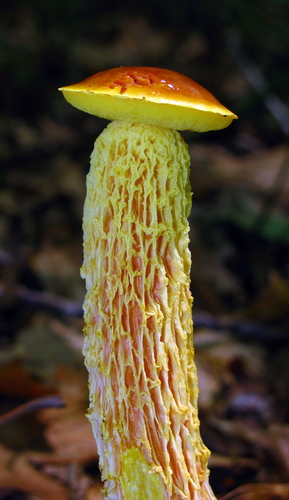


Shaggy-Stalked Bolete
aureoboletus betula
The Shaggy-Stalked Bolete, scientifically known as Aureoboletus betula, is a distinctive woodland fungus primarily recognized for its unique shaggy stalk and bright yellow pore surface. This fascinating species forms a crucial mycorrhizal relationship with birch trees, acting as a vital link in the forest ecosystem by facilitating nutrient exchange. While visually striking, it is generally considered an edible mushroom, though not highly prized by foragers due to its often fibrous texture and mild flavor compared to other bolete species. Its presence is a delightful indicator of healthy birch woodlands and a testament to the intricate subterranean networks supporting forest life.
生息地: Typically found growing terrestrially in deciduous or mixed woodlands, specifically in close mycorrhizal association with birch trees.
This bolete features a cap that ranges from 5 to 15 cm in diameter, typically golden yellow to brownish-yellow, and often sticky or viscid when moist. The pore surface underneath is bright yellow, and when bruised, it commonly stains a distinctive blue or greenish-blue. Its most identifiable feature is the robust stalk, measuring 5-12 cm tall and 1-3 cm thick, which is predominantly yellow but conspicuously covered with prominent, dark brown, shaggy scales, giving it its common name. The flesh is pale yellow and may also show a slight blue staining when cut.
カテゴリ
菌類レア度
Common
危険度
1/5 · 非常に低い
スナップ
最初にスナップしよう!
Although edible, the Shaggy-Stalked Bolete is not widely collected for consumption, often being passed over by foragers for boletes with a more desirable texture or flavor.
Its scientific name 'Aureoboletus' translates to 'golden bolete,' referring to the characteristic golden-yellow hues often seen on its cap and pores.
Like many boletes, its yellow pore surface will typically bruise blue or greenish-blue when handled or damaged, a common indicator of certain chemical reactions within the fungus.
The distinctive shaggy appearance of its stalk is caused by numerous dark brown scales against a lighter yellow background, making it easily identifiable.
Forms a beneficial symbiotic relationship with birch trees, where the fungus exchanges vital soil nutrients and water for carbohydrates (sugars) produced by the tree through photosynthesis.
Produces millions of microscopic spores from its intricate pore surface, which are effectively dispersed by wind currents, enabling the colonization of new habitats suitable for its growth.
While primarily mycorrhizal, its mycelial network plays a role in breaking down organic matter in the soil, contributing to the overall nutrient cycling and soil health within its woodland environment.
As a mycorrhizal fungus, Aureoboletus betula forms a symbiotic relationship with birch trees, primarily receiving carbohydrates (sugars) produced by the tree through photosynthesis. In return, the fungus helps the tree absorb water and essential mineral nutrients from the soil, such as phosphorus and nitrogen compounds.
Betula pubescens
Forms a vital mycorrhizal association with birch trees, exchanging nutrients for plant sugars.
Sciurus vulgaris
Squirrels and other small mammals may consume the fruiting bodies, aiding in the dispersal of spores through their droppings.
Mycetophilidae spp.
Larvae of various insect species, particularly fungus gnats, feed on the mushroom's flesh, contributing to its decomposition.
Penicillium spp.
Other fungi and molds, especially saprotrophic species, can colonize and decompose the bolete as it ages or if damaged.
このオブジェクトにはまだ特徴バッジが割り当てられていません。
まだ別名はありません。
テーマが追加されると、このオブジェクトのコレクションがここに表示されます。
危険度
1/5 · 非常に低い
まだ特別な安全上の注意はありません。
Shaggy-Stalked Boleteを識別する最も簡単な方法は、Snappit自然識別アプリを使用することです。
5-15 cm
0.05-0.5 kg
0 年
As a mycorrhizal fungus, Aureoboletus betula forms a symbiotic relationship with birch trees, primarily receiving carbohydrates (sugars) produced by the tree through photosynthesis. In return, the fungus helps the tree absorb water and essential mineral nutrients from the soil, such as phosphorus and nitrogen compounds.
Typically found growing terrestrially in deciduous or mixed woodlands, specifically in close mycorrhizal association with birch trees.
Foraging (absorption Through Mycelial Network)
ズームインしてクラスターを分割し、このオブジェクトが撮影された場所を探索しましょう。
新しい観察が追加されると、ここに最近のスナップが表示されます。